An editorial review of the story, characters, artwork and reading experience.
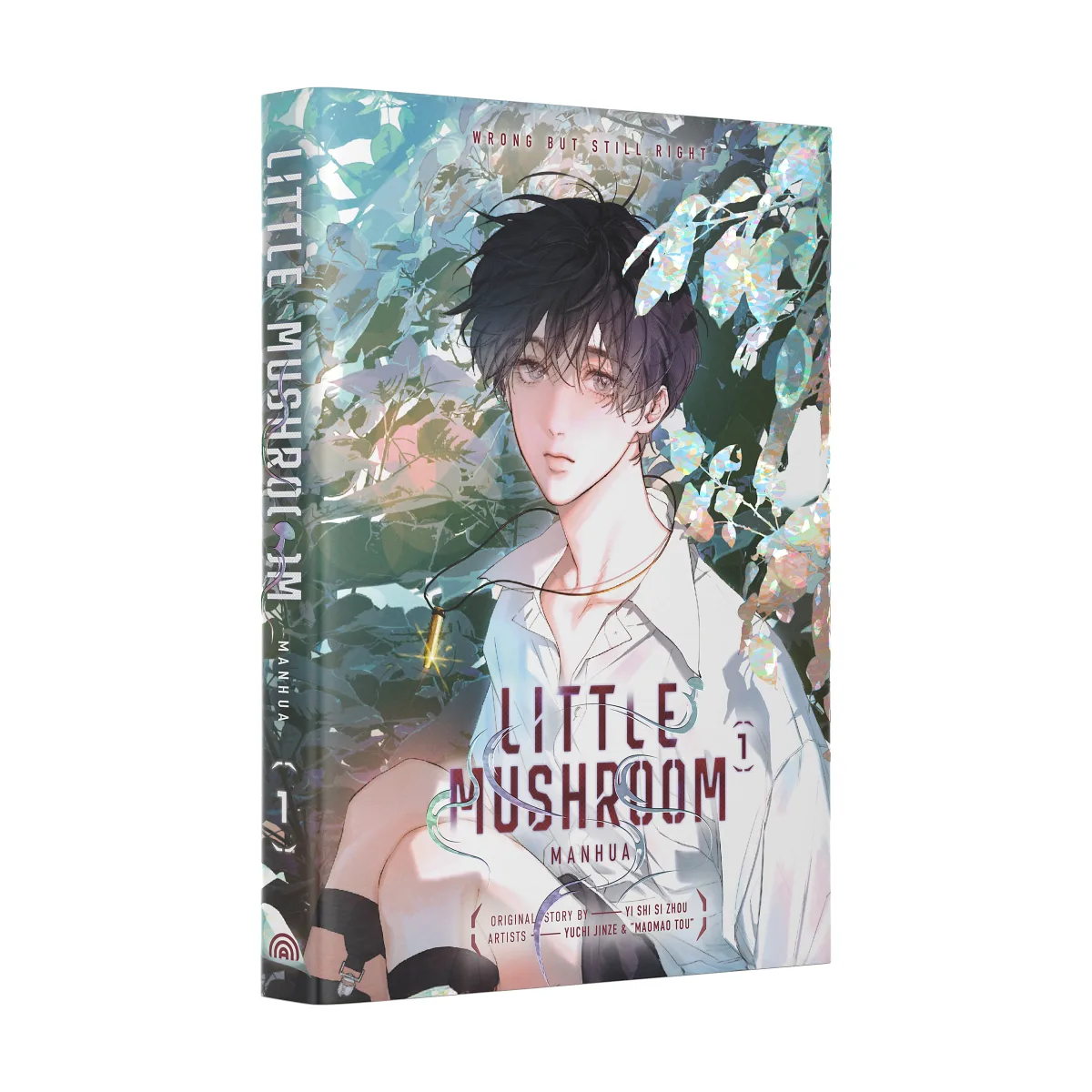
Official Little Mushroom English comic cover. Rights remain with the creators and publisher.Verdict
Little Mushroom turns an infiltration premise inside out. An Zhe is a nonhuman life-form wearing a human body, yet his attention to care and harm often feels more humane than the defensive system judging him. Lu Feng, the Supreme Judge, is frightening because his violence is institutional duty rather than private chaos.
The manhua preserves that moral tension while making the ruined ecology beautiful enough to invite a dangerous kind of wonder. It is a strong adaptation for visual readers, though the novel remains better at explaining how biology, identity and fear interact beneath the quiet surface.
Review scope and official edition
- The full-color manhua adapted from Yi Shi Si Zhou’s novel, with art credited by Aloha Comics to Maomao Tou.
- Aloha’s Volume 1 is an official English-language hardcover and full webtoon edition.
- Spoilers cover An Zhe’s infiltration premise but not later identity outcomes.
- Best for readers of post-apocalyptic science fiction, moral tension and restrained BL romance.
An Zhe and the cost of passing
An Zhe enters the base to recover his spore, but survival requires performing a human identity under constant observation. The story understands passing as labor: vocabulary, instinct and visible emotion can all expose him. His gentleness is not naivety so much as a different baseline for what life deserves.
That perspective lets familiar apocalypse rules look newly violent. Humanity has reasons to fear xenogens, and the manhua does not pretend every checkpoint is cruelty for its own sake. The discomfort comes from a system that may be understandable and still destroy the person standing in front of it.
Lu Feng, romance and moral pressure
Lu Feng is built as An Zhe’s natural threat: the person most capable of recognizing what he is. Their relationship develops through scrutiny, hesitation and altered decisions rather than immediate confession. Attraction matters because it disrupts a role that claims certainty is necessary for everyone’s survival.
Readers wanting a fast or openly expressive romance may find the pacing remote. The intimacy lies in what each character notices and what judgment is delayed. The comic’s faces and controlled color make that restraint legible without turning it into absence.
Art and adaptation limits
Mutated landscapes, spores and fortified human spaces receive distinct textures. The visual contrast makes ecology part of the story instead of a paragraph of lore. Quiet panels allow An Zhe’s smallness to register against systems built at an inhuman scale.
Compression can weaken the science-fiction reasoning. A term or biological change may arrive before its consequence has been fully established. The novel gives more room to uncertainty inside An Zhe; the manhua gives the environment a body. Readers may reasonably want both.
The print layout introduces another difference. A vertical webtoon can control pauses with scrolling, while a bound page places several beats in the reader’s peripheral vision. The official edition remains attractive, but panel rhythm may feel different from the original digital presentation even when no scene has changed.
Who should read it?
- Read it if you want a tender lead inside genuinely severe science fiction.
- Read it if slow-burn trust matters more than frequent romantic declaration.
- Skip or prepare carefully if dehumanization, execution or pandemic-style fear is difficult material.
- Choose the novel first if ecological explanation and internal voice are your main priorities.
Where to buy legally
Aloha Comics sells the official English full-color hardcover edition and identifies it as the full webtoon version. Simon & Schuster distributes later volumes and provides ISBN and publication details. Check the volume number before ordering; the novel and manhua are separate product lines.
Content pressure beneath the quiet presentation
Soft color and restrained dialogue can obscure how severe the setting is. The story includes institutional killing, dehumanization, bodily transformation and survival decisions made under mass fear. It does not present those elements as a sequence of shocks, which can make their moral weight linger longer.
Readers looking primarily for comforting romance should enter with that distinction. Tenderness exists because the world gives characters reasons to deny it. The relationship is not a separate reward pasted onto the apocalypse; it is one of the ways the story tests what a person is allowed to count as human.
Reading the official print edition
The hardcover is useful for readers who want stable translation, durable color reproduction and clear volume metadata. It is not yet the same thing as owning a complete story. Check the publisher’s current volume list and release dates before deciding whether to collect or wait.
Because the novel and manhua use similar English branding, confirm that a listing says comic, manhua or full-color webtoon edition. Cover art alone is unreliable. This small check prevents readers from ordering prose when they expected panels—or assuming a later volume number belongs to the same format.
Frequently asked questions
Is Little Mushroom a manhua or novel?
It began as a Chinese novel and has a full-color manhua adaptation. This review covers the comic edition.
Is there an official English manhua?
Yes. Aloha Comics labels its hardcover as an English-language, full-color, full webtoon edition.
Is the story romance or science fiction?
Both. The relationship develops inside a post-apocalyptic ecological conflict; removing either element would change the story’s moral pressure.
Continue reading
Continue with Romance manhua guide, Best manhua by genre, or Manhua reviews.
Sources and verification
- Aloha Comics — primary source
Official source · accessed 26 Aug 2026 - Simon & Schuster
Official source · accessed 26 Aug 2026