Verdict and format clarification
Battle Through the Heavens is a Chinese manhua adaptation of Tiancan Tudou’s web novel, even though “Battle Through the Heavens manga” remains a common search. The comic offers a fast, accessible visual version of Xiao Yan’s rise, but speed creates continuity and character costs.
The story’s basic engine remains strong: a former genius loses status, discovers the reason, and rebuilds through training, alchemy and difficult alliances. Familiarity does not make the structure ineffective when setbacks have social weight.
Review scope and quick facts
- Scope: the official WebNovel comic catalog and the manhua’s established early-to-middle cultivation progression.
- Publisher credit on WebNovel: Zhiyin Comic & Animation Company.
- Source: web novel Doupo Cangqiong by Tiancan Tudou.
- Format: Chinese color manhua; separate from the novel, donghua and live-action versions.
- Spoilers: premise and adaptation structure only.
Why the fallen-genius hook lasts
Xiao Yan’s loss of ability is public. Family expectations, broken respect and a damaged engagement turn the problem into identity rather than statistics. Recovery therefore provides both competence and the repair of social agency.
Yao Chen gives the climb a mentor relationship and introduces alchemy as a second system of value. Combat strength can win a confrontation; rare medicine, knowledge and craft reshape the network around it.
Cultivation and alchemy
The progression system succeeds because advancement changes available choices. New realms open travel and conflict, while alchemy creates obligations and bargaining power. Resources matter enough that the world does not feel like a private interface serving only the protagonist.
Later escalation can blur distinctions. New flames, ranks and factions arrive rapidly, and comic compression sometimes explains importance after the reveal. A consistent translation is essential because rank naming varies across English sources.
Pacing and adaptation friction
The manhua is efficient when converting long novel explanation into visual goals. Training, preparation and confrontation can flow in a clean vertical sequence. It is less successful when internal conflict or politics becomes a few caption boxes between action scenes.
Comic relief also alters tone. Exaggerated reactions make the long journey lighter, but they can reduce dignity during serious transitions. Readers comparing the novel or donghua should expect scenes to carry different emphasis rather than search for one perfectly faithful version.
Characters and relationships
Xiao Yan is appealing when pride and responsibility compete. Pure revenge would be thin; loyalty to family and mentors gives the climb direction beyond humiliation. Yao Chen remains the most important counterweight because he can challenge method as well as strength.
The large cast expands the world but receives uneven interiority. Romantic and faction relationships sometimes become milestones on the route rather than independent sources of change. The adaptation is strongest when an ally’s need interrupts Xiao Yan’s planned ascent.
Artwork and action readability
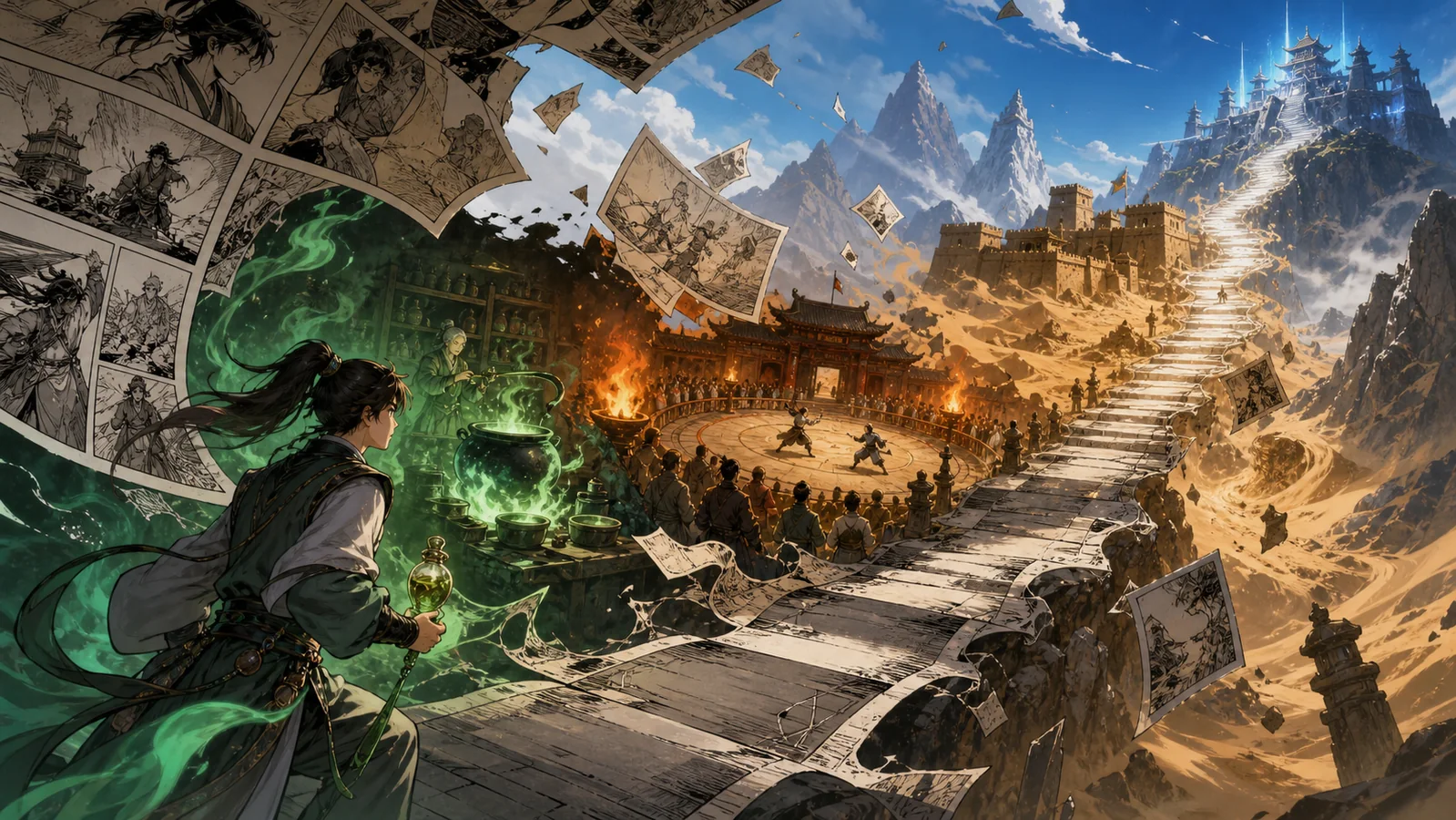
Color distinguishes flames, techniques and factions efficiently. Alchemy scenes create a welcome craft vocabulary beyond combat, while major techniques receive clear scale. Anatomy and background density vary across a very long production.
The comic can crowd explanations into action panels. When effects, rank names and dialogue compete, the reader understands that a moment is important before understanding why. This is a presentation problem, not proof that the underlying system lacks logic.
Manhua, novel or donghua first?
Choose the manhua for speed and color, the novel for internal detail, and the donghua for moving spectacle. None is a neutral substitute for the others. A newcomer who dislikes 3D animation may prefer the comic; a reader confused by compressed politics may prefer the novel.
Avoid mixing chapter numbers across editions. Adaptations divide and rearrange material differently, and unofficial numbering can make comparison worse.
Who should read it?
- Best for readers wanting a classic cultivation rise, alchemy and large faction adventure.
- A good bridge from donghua to Chinese comics if fast pacing is welcome.
- Skip if translation inconsistency or long escalation chains quickly become tiring.
- Read through an authorized platform where available; do not rely on scan sites that erase credits and reorder chapters.
Humiliation, promise and long-term motivation
The broken-engagement material is memorable because it turns private weakness into public judgment. Xiao Yan’s response is not immediately noble; pride and anger are real fuel. The story gains durability when those motives expand into care for family, teacher and companions rather than remaining a single delayed rematch.
Cultivation progression can otherwise become an endless postponement of self-worth. Battle Through the Heavens is strongest when a new realm changes what Xiao Yan owes people, not merely how many opponents must acknowledge him.
Alchemy gives the world an economy
Pills and flames are not only combat upgrades. They create markets, professions, patronage and dependence. An alchemist can influence a faction without leading its army, which gives the world more than one hierarchy. The manhua’s color makes this craft visually immediate.
Compression sometimes turns preparation into a montage of ingredients and results. Readers wanting process, failure and internal reasoning will find more of that texture in the novel. The comic remains effective when the recipe’s social consequence is clearer than its technical explanation.
Official availability versus a complete English run
An official catalog page confirms authorization; it does not guarantee that every source chapter is available in every language or region. WebNovel lists the comic and its publisher, but readers should inspect the current chapter list and purchase model before committing.
Do not fill gaps with a random scan source and then blame the manhua for broken naming. Unlicensed versions may merge chapters, replace rank terms and omit credits. If the licensed English run is incomplete, the honest answer is that legal availability has a gap—not that piracy becomes an official edition.
Final verdict
Battle Through the Heavens remains foundational because its climb links power to craft, status and responsibility. The manhua preserves that pleasure in a highly readable visual form, but its hurry can flatten relationships and complicate terminology. It is worth reading with the expectation of adaptation, not transcription.
Frequently asked questions
Is it manga or manhua?
It is manhua, a Chinese comic. “Manga” appears frequently in platform titles and search queries but is not the precise origin label.
Is the manhua the same as the donghua?
No. Both adapt the same source novel but use different pacing, visual production and scene emphasis.
Where is an official English edition listed?
WebNovel lists an official comic credited to Zhiyin Comic & Animation Company. Availability and chapter access can change by region.