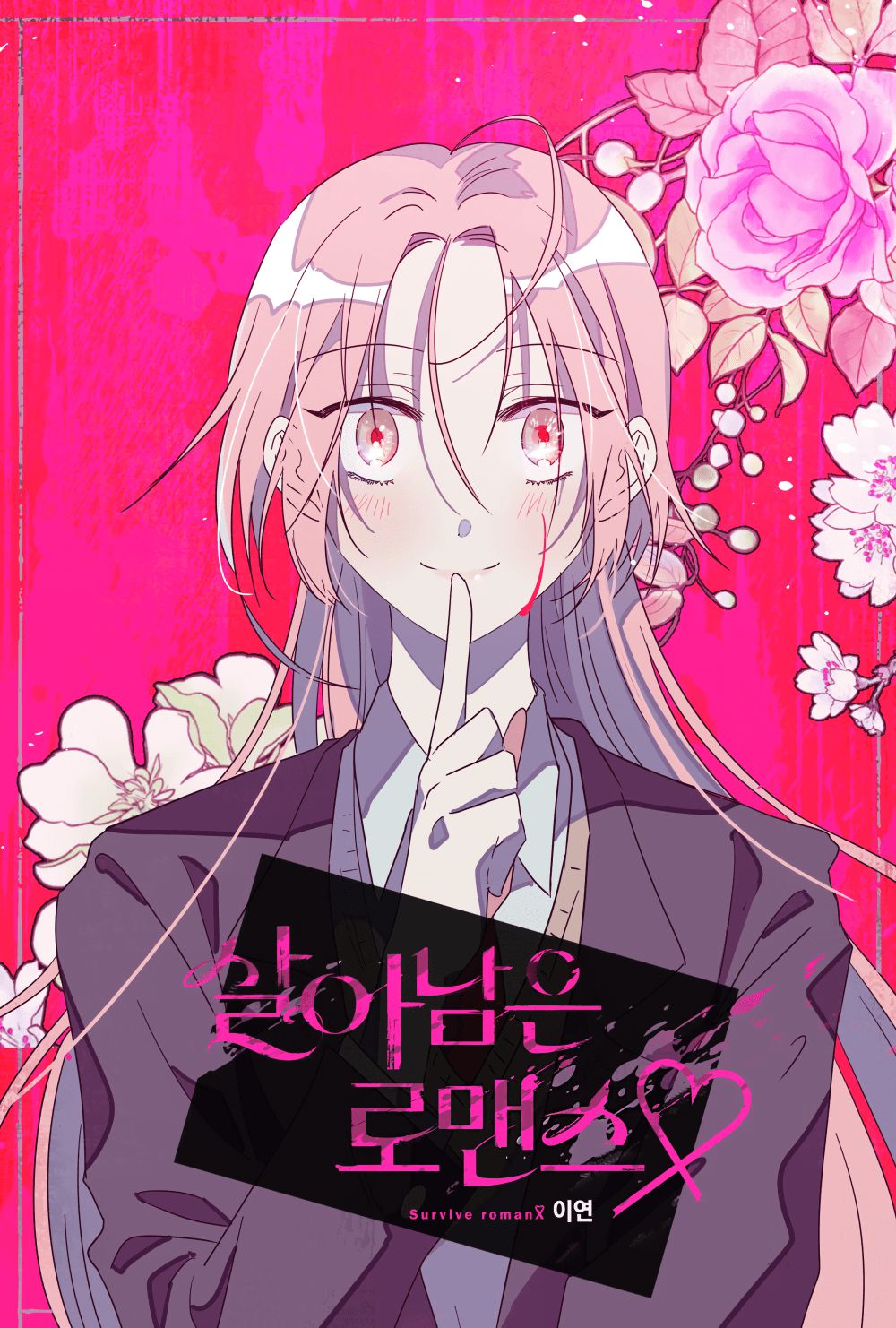
The short verdict
Surviving Romance is best approached with as little plot knowledge as possible. Its opening resembles a familiar reincarnation fantasy: Chaerin Eun wakes inside a romance novel, occupies the heroine's role and expects the story to reward her once she reaches the correct confession. Then the script fails.
What follows is not a simple parody of romance. Lee Yeon uses the collapse of one genre to ask a sharper question: what happens when a protagonist finally sees the people around her as complete human beings rather than background characters? That question gives the horror its purpose and turns a clever hook into an unusually generous ensemble story.
What is Surviving Romance about?
Chaerin believes she understands her new world because she has read the novel that controls it. She knows the love interest, the important scenes and the happy ending she is supposed to reach. Her certainty disappears when a violent outbreak transforms the school into a survival space and the expected male lead can no longer deliver the ending.
She also faces a more disturbing limitation: classmates outside the original narrative are difficult for her to recognize as individuals. They are “extras” because the story taught her to look past them. Survival therefore requires more than escaping danger. Chaerin must learn names, listen to perspectives the novel ignored and give up the comforting belief that only her route matters.
The genre reversal is more than a twist
Plenty of series surprise the reader by switching tone. Surviving Romance goes further by making that switch its central argument. Romance logic tells Chaerin that one chosen relationship will solve the story. Horror reveals how fragile that assumption is. A single idealized person cannot protect a classroom, understand every threat or repair a narrative designed to erase everyone else.
The shift also changes how familiar visual symbols work. Flowers, confessions and school corridors begin as romantic shorthand, then return under pressure. The result is not a rejection of affection; it is an expansion of what love and loyalty can include.
Chaerin becomes a protagonist by surrendering control
Chaerin is not immediately selfless, and the story is stronger for it. She begins with the habits of someone who thinks she has already read the answer key. When events refuse to obey, she can become impatient, secretive and overly willing to treat other people as pieces in another attempt.
Her growth comes through failure. Each new decision forces her to recognize knowledge she lacks and pain she did not notice. She does not become compelling because she acquires the strongest ability. She becomes compelling because she gradually accepts that leadership is impossible without trusting people who can contradict her.
The female ensemble is the real heart of the series
The classmates are not interchangeable survivors waiting for Chaerin to inspire them. They bring conflicting fears, practical skills, grudges and relationships that existed before the protagonist learned to see them. Several early impressions are deliberately incomplete. A character who looks cowardly may understand risk better than the loudest fighter; someone framed as difficult may be the only person asking a necessary question.
This matters because the story's emotional movement runs in the opposite direction from conventional power fantasy. Progress means distributing importance. The more Chaerin trusts the group, the less the world resembles a novel built for one heroine—and the more alive it feels.
How well does the horror work?
The immediate threat is effective, but the best horror comes from uncertainty about the rules. What resets? Who remembers? Why do some choices produce different results? Can a person remain themselves when the narrative insists on assigning them a role? These questions keep familiar school-survival spaces unstable.
Lee Yeon is also good at withholding faces, names and visual certainty. The device could have remained a gimmick; instead, it places the reader inside Chaerin's limited perception. When individuality becomes visible, the change carries emotional meaning.
Where Surviving Romance struggles
The middle can feel repetitive. Repetition is structurally important, yet another failed plan occasionally communicates less than the previous one. Readers impatient with loops may feel the intended exhaustion too literally.
The rules arrive in layers. Some late explanations ask the audience to absorb a large amount of narrative machinery while emotional conflicts are also reaching their peak.
The title creates the wrong expectation for some readers. Anyone seeking a romance-led isekai may feel misdirected. That misdirection is purposeful, but purpose does not guarantee compatibility.
Is Surviving Romance actually a romance?
Not in the conventional sense suggested by its title. A romantic route initiates the story, but survival, friendship, identity and collective agency become much more important. Readers should not begin expecting a sustained courtship or a central couple carrying every arc.
Is the ending satisfying?
Without revealing its final mechanics, the ending follows the story's central values: people cannot be reduced to the function a narrative assigned them, and an escape that preserves only the designated heroine would not be a complete victory. It is more interested in emotional and thematic closure than in preserving the original genre.
The final stretch becomes conceptually dense, but it does not abandon the ensemble that gave the series weight. Readers who paid attention to names, memories and acts of recognition receive the strongest payoff.
Who should read it?
Read it if you enjoy stories that interrogate their own genre, or if you want isekai where prior knowledge becomes a limitation rather than an unlimited advantage. It is also a strong recommendation for readers tired of background characters existing only to praise the lead.
Skip it for now if zombie horror is a hard limit, if repeated timelines frustrate you, or if your main goal is a romance with a clearly dominant couple.
Final verdict
Surviving Romance begins by denying its heroine the ending she expected. Its more important achievement is showing why that expected ending was too small. Chaerin cannot survive by performing the heroine's role more perfectly; she survives by recognizing lives the original story treated as disposable.
The result is tense, occasionally exhausting and far warmer than its horror imagery suggests. The series earns its 4.5/5 not because every loop is perfectly paced, but because its formal tricks, character development and final argument point in the same direction.
Frequently asked questions
Is Surviving Romance worth reading?
Yes. It is especially worthwhile for readers who enjoy psychological horror, female ensemble casts and isekai that challenges protagonist-centered storytelling.
Is Surviving Romance completed?
Yes. The official English WEBTOON lists the series as completed.
Does Surviving Romance have a happy ending?
The conclusion provides meaningful emotional closure, but explaining whether every outcome is conventionally happy would spoil the final arc.
Where can I read it legally?
The official English release is available on WEBTOON. Availability and unlock conditions may differ by region.
Sources and verification
- WEBTOON — primary source
Official platform · accessed 25 Aug 2026