Verdict and scope
This review covers the official English WEBTOON release through episode 609, published on 15 August 2026. It discusses the series’ long-term genre shift without revealing late outcomes.
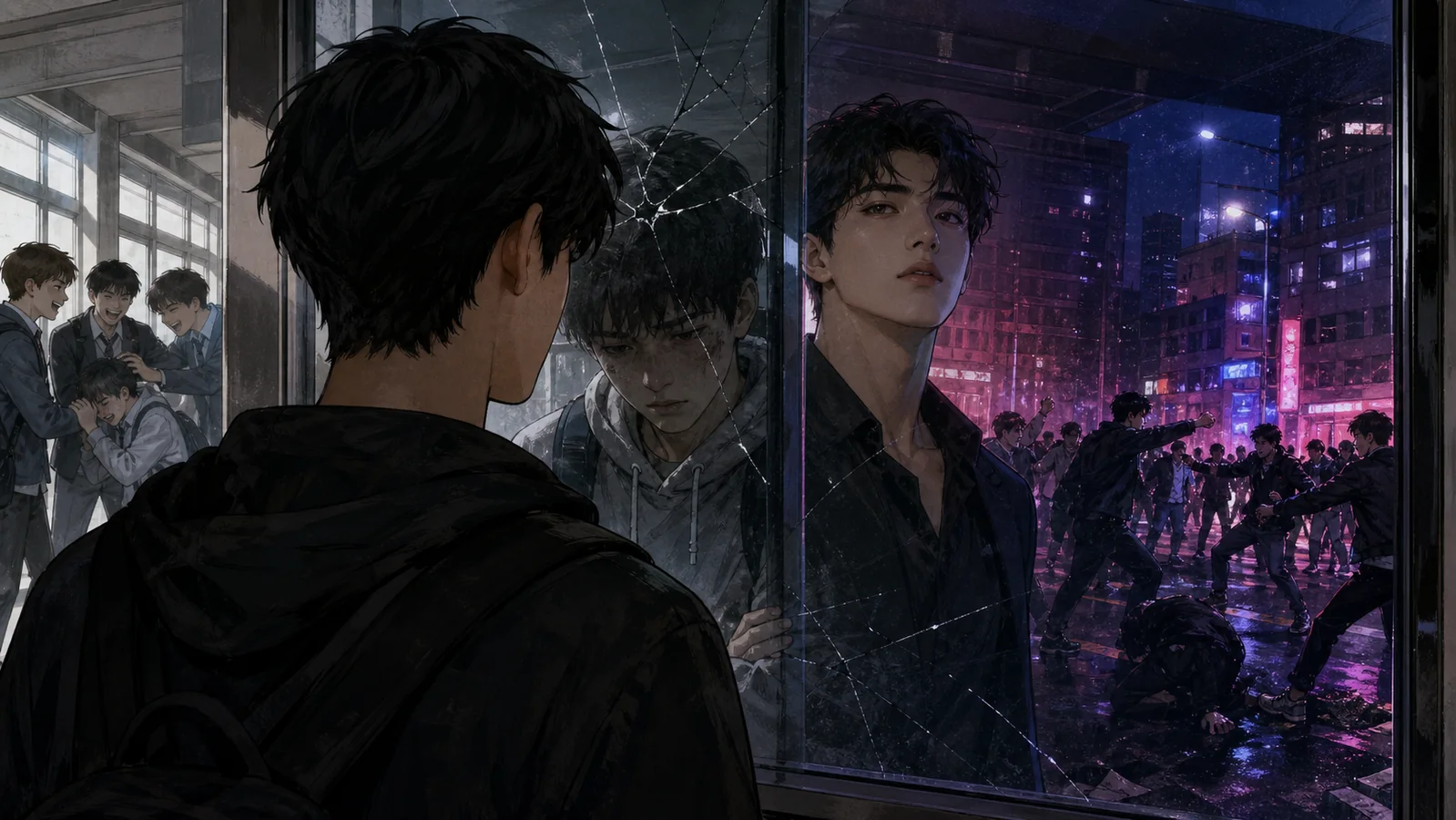
Lookism is ambitious enough to outgrow its title. It begins with a brutal, accessible question—how differently is the same person treated in a conventionally attractive body?—and expands into class systems, exploitation, chosen family and organized street violence. Growth creates some of its best characters and also makes the original dramatic promise harder to locate.
Quick facts
- Creator: Taejun Pak.
- Format: ongoing Korean webtoon/manhwa; official English edition on WEBTOON.
- Current official English page: more than 600 episodes and an “up every Sunday” schedule at the time checked.
- Content: mature themes including bullying, violence, exploitation and body-image harm.
- Best for: readers comfortable with a social drama becoming a long action ensemble.
Why the double-body premise works
Daniel can move between a marginalized body and a socially rewarded one. The device does not need a lecture to prove the double standard; ordinary interactions change immediately. Service, friendship, suspicion and opportunity become experiments conducted on the same consciousness.
Early Lookism is sharp because the fantasy does not erase habit. Daniel carries fear and learned avoidance into the attractive body. Confidence is not a free cosmetic upgrade, and kindness from others can be both welcome and indicting.
Appearance, class and social power
The series links beauty to money, clothing, school hierarchy and physical safety. Its broad comedy can simplify people into visual types, but the better arcs complicate first impressions and ask who benefits from keeping a hierarchy legible.
Lookism is less persuasive when appearance becomes a shortcut for moral revelation in the opposite direction. Not every cruel character needs hidden pain, and not every transformation repairs the structural critique. The story’s strongest empathy comes from sustained choices, not surprise backstory.
The shift into a gang and action epic
Action is present early, but it eventually becomes the architecture. Crews, businesses, fighting styles and inherited conflicts expand until school-life episodes feel like another era. The shift is gradual enough to retain readers yet large enough that someone recommending “a body-swap drama” should disclose it.
The action era brings excellent payoffs for side characters and sharper visual choreography. It also lengthens the distance between the title’s question and the current conflict. Power scaling begins to organize attention in the way beauty once did.
Supporting cast and Daniel’s place
Several supporting characters become more emotionally specific than Daniel because they must live with one body, one history and the consequences of visible choices. Friendship arcs that begin as jokes can become the series’ most durable work.
Daniel grows in both confidence and ability, but the expanding ensemble occasionally turns him into a connector between more focused stories. That is not automatically a failure. It does mean readers invested only in the original mystery will experience long detours.
Artwork, pacing and reader fatigue
The art improves dramatically across the serialization. Anatomy, action continuity and facial intensity become more controlled, and major fighters gain instantly readable movement identities. The evolution is rewarding when reading from the beginning rather than jumping to polished late images.
Weekly escalation produces repetition. Large arcs introduce several layers of command, flashback and reversal before resolving. Reading in batches can improve continuity but also exposes how often a new stronger figure delays closure.
Manhwa and anime orientation
Netflix’s animated adaptation is an entry point to the early social-drama premise, not a replacement for the scope of the webtoon. Anime viewers continuing in the official comic should begin near the start if they care about omitted context and the art’s evolution.
Do not jump directly into late gang arcs because clips make them look exciting. The relationships that give those conflicts weight are built across hundreds of episodes.
Who should read it?
- Read if you enjoy large casts, social themes, street action and long-running weekly worlds.
- Read if a story changing genre feels like expansion rather than betrayal.
- Skip if you need the body-swap mystery to remain the continuous central plot.
- Pace yourself if unresolved arc layers create fatigue; the series is a marathon, not a weekend recommendation.
The title’s argument is deliberately uncomfortable
Lookism does not begin by claiming that inner goodness automatically defeats prejudice. Daniel receives opportunities because appearance changes how others read him. The unfairness is immediate, and his participation in that new privilege is part of the discomfort. He is victim, observer and beneficiary at different moments.
The series becomes less precise whenever beauty functions like another combat stat. Its strongest social writing returns to ordinary transactions—who gets believed, hired, protected or mocked—where structural bias cannot be punched away.
Violence as social language
Fighting initially exposes hierarchy. Characters use force because school and adult institutions fail to protect vulnerable people. Later, fighting becomes a culture with its own legends, techniques and inherited status. That evolution is exciting but risks normalizing the same dominance the early story criticized.
The best action arcs preserve consequence through injury, loyalty and economic control. The weakest treat another physically exceptional teenager as sufficient escalation. Readers can enjoy the choreography while still questioning what the shift does to the original theme.
Reading 600-plus episodes responsibly
A long archive encourages bingeing until individual arcs blur. Reading in deliberate blocks makes the genre changes easier to process and reduces the temptation to skip early social material for later fights. Official WEBTOON arc titles provide natural stopping points.
The mature rating should be taken seriously. Bullying, humiliation and violence are not occasional edge decoration. Readers sensitive to body-image abuse or sustained assault may need summaries or content warnings before particular arcs.
Final verdict
Lookism remains worth following because its world has accumulated real human attachments, not because every expansion is disciplined. The early chapters see social cruelty with unusual directness; the later chapters deliver an ambitious action ensemble whose scale sometimes obscures that insight. Readers should choose it knowing they are accepting both versions.
Frequently asked questions
Is Lookism finished?
The official English WEBTOON page remained active with a weekly schedule when checked in August 2026. Individual arcs may end, but the series page should be treated as ongoing unless the publisher changes its status.
Is Lookism mainly romance?
No. Romance is secondary to social drama, identity, friendship and eventually action conflict.
When does it become action-heavy?
The transition is gradual rather than one clean chapter. Crew conflicts become increasingly central after the school-focused opening material.