Verdict
Solo Leveling understands the pleasure of visible progress better than almost any gateway manhwa. Every goal has a readable cost, every victory produces a concrete change, and the vertical format turns those changes into dramatic reveals. It is extremely easy to continue reading.
Its limitation is built into the same design. As Sung Jinwoo becomes the answer to every threat, rivals, allies and institutions lose dramatic weight. The story gains scale but sheds friction. That trade is acceptable for readers seeking spectacle; it becomes frustrating for readers who want an ensemble to matter.
Review scope and quick facts
- Scope: all 202 episodes in the completed Tapas edition, including the special side-story episodes.
- Creators: original story by Chugong; comic adaptation credited to h-goon, DUBU/REDICE STUDIO and DISCIPLES/REDICE STUDIO.
- Format: completed Korean color webtoon/manhwa adapted from a web novel.
- Spoiler level: mild structural spoilers, no final-arc outcome.
- Legal English options: Tapas and Tappytoon digitally; Yen Press/Ize Press in collected volumes.
The premise without the recap
Gates connect the modern world to monster-filled dungeons, and awakened hunters enter them for money and survival. Jinwoo begins at the bottom of that economy. A lethal dungeon leaves him with access to a private System that measures growth like a game and allows him to improve in ways no other hunter can.
The hook is not merely that he becomes strong. It is that the manhwa makes every stage of becoming strong visible. Statistics, equipment, class abilities and summons create a chain of short-term questions even when the long-term answer—Jinwoo will rise—is obvious.
Why the progression loop works
Goals arrive before explanation grows stale. A dungeon establishes a ceiling, a quest turns that ceiling into a target, and a later spread converts the achievement into scale. The structure repeatedly pairs uncertainty about method with confidence about outcome. Readers can relax into the fantasy while still wondering how the next encounter will be solved.
Cliffhangers are placed for scroll reading rather than print-page imitation. Negative space delays a reveal; long vertical descents make monsters feel enormous; narrow reaction panels accelerate the approach to a full-width impact. The interface elements are not decoration—they make improvement legible at a glance.
Artwork and vertical direction
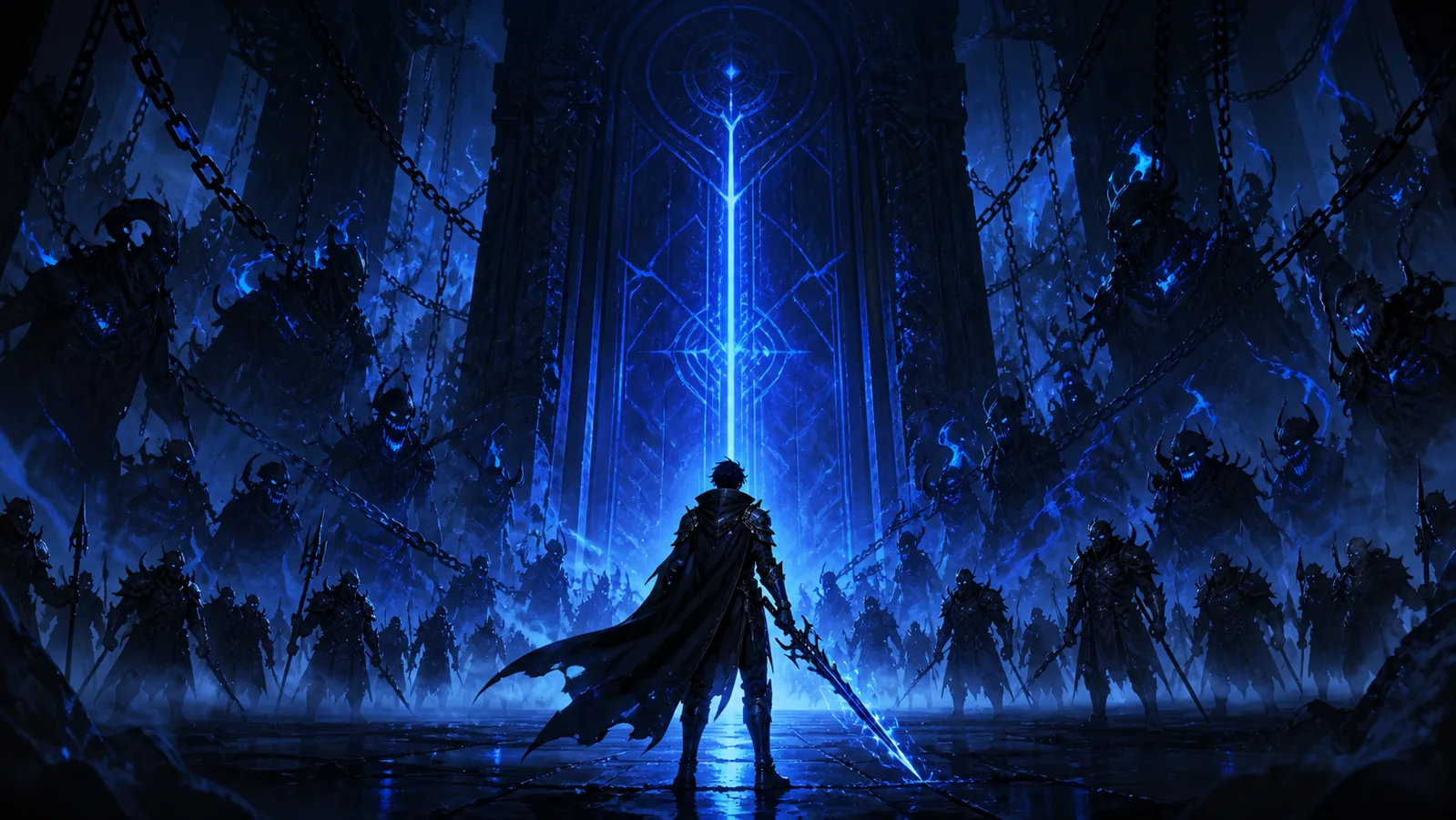
DUBU’s art gives Solo Leveling its authority. Monsters have clean, memorable silhouettes, and effects rarely obscure the subject of a panel. Blue-black shadow effects create a stable visual identity as the number of combatants increases. Environments can become secondary during long fights, but scale remains easy to read.
The color design performs narrative work. Weakness is associated with sickly light and confined rooms; later power is staged in deep blacks and luminous blues that reserve space around Jinwoo. The visual confidence can make a simple confrontation feel ceremonial.
Jinwoo and the cost of a one-man curve
Early Jinwoo has immediate human pressure: medical bills, family responsibility and the humiliation of being visibly fragile in a dangerous profession. Those motives make his discipline sympathetic. As his capacity expands, the story increasingly communicates personality through composure and dominance rather than uncertainty.
That creates emotional distance. Jinwoo remains satisfying to follow, but he becomes less surprising as a person. The best later moments reconnect overwhelming power to family or memory; the weakest treat an already decided hierarchy as suspense.
Supporting cast and pacing
Several hunters arrive with enough design and motivation to anchor their own arcs. The power curve often turns them into witnesses. Institutions can identify danger, mobilize resources and react to Jinwoo, but few retain the ability to change the outcome once he enters the scene.
The middle of the run is the manhwa’s most efficient stretch: the world opens while the central loop still contains risk. Late arcs escalate quickly and compress geopolitical or supernatural consequences that could have supported more character conflict. The side stories restore warmth and give the ending more room to breathe.
Manhwa, anime and novel
The manhwa is the fastest visual version and the easiest place to appreciate the vertical staging that defined its reputation. The anime adds performance, music and moving choreography while reorganizing emphasis for television. The novel contains more internal explanation and connective tissue.
Anime viewers do not need to restart for basic comprehension, but beginning at episode one is worthwhile if the purpose is to compare pacing and art. Chapter-to-episode mapping varies, so an official volume or episode guide is safer than jumping from a random recap number.
Who should read it?
- Read it if you enjoy hunter systems, decisive protagonists, monster design and fast visual storytelling.
- Read it as a first manhwa if you want a polished introduction to vertical-scroll action.
- Skip it if invincible-protagonist stories need a strong ensemble to hold your attention.
- Temper expectations if political complexity or slow relationship development is your priority.
The economics underneath the fantasy
Before the System becomes dominant, hunting is labor. Rank controls income, danger and how much dignity a worker is permitted to keep. Jinwoo enters dungeons because weakness does not remove financial responsibility. That material pressure makes the opening more convincing than a generic desire to be number one.
As the story moves toward global threats, the labor framework fades. Guilds and governments still calculate value, but Jinwoo increasingly stands outside the economy that formed him. The change is narratively logical and thematically costly: a grounded story about survival becomes a myth about exceptional authority.
What the ending resolves—and what it avoids
Without describing the final mechanism, the ending chooses restoration over a public accounting of everything that happened. It satisfies the protective impulse that drives Jinwoo and gives the side stories room for domestic warmth. It also reduces opportunities for institutions and supporting characters to process the world they helped defend.
Readers who value Jinwoo’s personal promise may find that choice moving. Readers invested in collective consequence may feel that the story solves pain by removing witnesses. The disagreement is useful because it reveals what Solo Leveling has prioritized all along: one person’s capacity to carry a burden that the wider cast cannot share.
Reading experience and edition choice
The digital vertical edition preserves the original reveal timing most naturally. Print volumes rearrange that flow into pages and offer a collectible physical format, but some towering drops and pauses cannot feel identical. Neither format is inherently wrong; the choice depends on whether scroll rhythm or physical ownership matters more.
Use the credits on Tapas, Tappytoon or Yen Press to distinguish the main comic from Solo Leveling: Ragnarok and from the prose novel. Search results frequently mix all three. A listing that omits the licensed creators or presents cropped chapters outside an official platform is not a reliable edition.
Final verdict
Solo Leveling is not secretly a deep ensemble drama, and it does not need that defense. It is an expertly delivered progression fantasy whose art, rhythm and reward structure made an entire mode of manhwa legible to a global audience. Its weaknesses are real: emotional range narrows, side characters lose agency and escalation eventually substitutes for uncertainty.
For the reader it suits, those weaknesses interrupt rather than destroy the experience. Few completed action manhwa are easier to start, and even fewer maintain this level of visual momentum across a full run.
Frequently asked questions
Is the Solo Leveling manhwa completed?
Yes. Tapas labels the 202-episode English comic as completed, including its special episodes.
How many English print volumes are there?
Yen Press currently lists fifteen comic volumes, with the last two identified as side-story volumes. Check the publisher catalog for the latest format and regional availability.
Where can it be read legally?
Tapas and Tappytoon carry licensed English digital editions. Yen Press/Ize Press publishes the collected English comic.