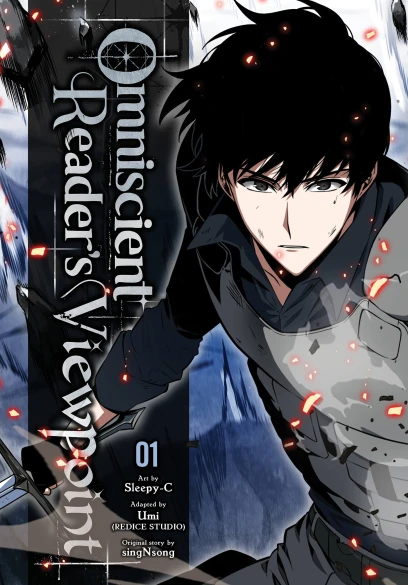
The short verdict
Omniscient Reader’s Viewpoint begins with a premise that sounds engineered for instant gratification: the only person who finished an unpopular web novel watches its apocalypse become real. Kim Dokja knows the coming scenarios, the hidden rewards and the man who was supposed to be the protagonist. He should therefore be unbeatable.
The manhwa is smarter than that shortcut. Information gives Dokja leverage, but it never gives him complete control. People behave differently once he enters their story. His memory has gaps. Powerful spectators turn suffering into entertainment. The further he changes events, the less safely he can rely on the text that once protected him. What starts as a clever survival fantasy gradually becomes a story about authors, readers and characters fighting over who gets to decide what a life means.
What is Omniscient Reader about?
Kim Dokja is an ordinary office worker whose one constant is the serialized novel Three Ways to Survive the Apocalypse. When its final chapter arrives, the world around him is forced into the novel’s lethal “scenarios.” Dokja survives not because he is the strongest person in the subway, but because he recognizes the rules before anyone else does.
That knowledge brings him into conflict—and eventually cooperation—with Yoo Joonghyuk, the novel’s original protagonist. Joonghyuk can repeat ruined timelines; Dokja has read them. Their relationship is the engine beneath the monsters, constellations and escalating scenarios: one man has endured the story, while the other believes that reading it means he understands.
Why the premise keeps working after the novelty fades
Many system stories explain danger through floating windows, then reduce every problem to a larger statistic. ORV uses rules as moral traps. A scenario may reward efficiency while punishing compassion, or force a group to choose who counts as expendable. Dokja’s best victories come from reading the intention behind a rule, not merely exploiting a numerical loophole.
The constellation system adds another sharp idea: disaster is content. Mythic beings sponsor human “incarnations,” spend currency on the scenes they enjoy and complain when a scenario becomes boring. It turns the familiar experience of watching fictional suffering into part of the world’s power structure. The reader is invited to enjoy the spectacle, then made slightly uncomfortable about that enjoyment.
Kim Dokja is compelling because knowledge has a cost
Dokja is observant, funny in a dry and defensive way, and capable of frightening calculation. He also treats himself as less real than the people he once read about. That contradiction makes him more interesting than a conventional overpowered lead. He will gamble everything on a plan, yet struggle to accept that other people might choose him rather than the outcome he can deliver.
The manhwa cannot reproduce every layer of his prose narration, but it communicates the gap visually: the composed expression, the private calculation and the moments when his companions realize he has withheld part of the plan again. His competence creates momentum; his habit of deciding alone creates the emotional conflict.
The supporting cast prevents a one-man walkthrough
Yoo Joonghyuk is deliberately difficult: proud, exhausted and shaped by failures nobody else remembers. Reducing him to Dokja’s rival misses the point. He represents the cost of living through the story rather than observing it. Their friction gives both characters a limit the other can expose.
Yoo Sangah, Jung Heewon, Lee Hyunsung, Lee Gilyoung and the wider company are not simply slots in a battle formation. The strongest arcs let them challenge Dokja’s habit of treating the future as a script. Not every member receives equal depth, especially as the cast expands, but the group develops enough personality that a scenario matters for more than whether Dokja’s prediction proves correct.
Art built for scale—and for a phone screen
Sleepy-C and the 3B2S Studio team make complicated action unusually legible. Character silhouettes remain distinct, attacks have direction, and long vertical reveals give monsters and constellations the scale the story demands. The palette shifts comfortably from cold subway tension to explosive mythic spectacle without losing the faces inside it.
The adaptation is especially good at entrance moments and scenario climaxes. Occasionally it leans so hard on polished impact panels that quieter transitions feel compressed. Even so, this is not decoration placed over prose. The vertical-scroll composition does real adaptation work, turning explanations, reveals and spatial danger into a rhythm designed for the format.
Where the manhwa struggles
The terminology arrives fast. Attributes, stigmas, stories, coins, sponsors and scenario conditions can crowd the page. Readers who dislike rule-heavy fantasy may feel they are studying the system before they have time to care about the people.
Escalation can blur together. ORV repeatedly expands from one impossible crisis to a larger one. The thematic through-line remains strong, but some mid-arc explanations and reversals feel like scaffolding between major emotional payoffs.
The adaptation necessarily loses interior detail. Dokja’s relationship with language, interpretation and self-deception is richer in prose. The manhwa is clearer and faster; the novel is more intimate. That is a trade-off, not a failure, but readers arriving from the novel will notice it.
Manhwa or web novel: which should you read first?
Start with the manhwa if you want the easiest entry, strong visual action and a cast you can distinguish immediately. Start with the web novel if Kim Dokja’s inner voice, long-form setup and metafiction are the main attraction. Reading both is not redundant: the comic clarifies spectacle and space, while the prose gives the ideas more room to echo.
Do not try to match random chapter numbers across formats. The adaptation divides and packages material differently. Use our Omniscient Reader’s Viewpoint reading order for a format-by-format route through the official English editions.
Who will enjoy Omniscient Reader?
Fans of Solo Leveling may arrive for polished action, but ORV is less interested in the pleasure of becoming untouchable. It is a better fit for readers who enjoy plans going wrong, alliances changing the “known” plot and stories that eventually examine their own audience.
Final verdict
Omniscient Reader’s Viewpoint earns its popularity by doing more than delivering a smart protagonist inside a deadly game. It asks whether knowing a person’s story is the same as knowing them—and whether a reader can step inside a narrative without trying to own its ending.
The terminology is heavy and the scale sometimes outruns the pacing, but the central relationships give the spectacle weight. For readers who want action with strategy, an ensemble worth protecting and a metafictional idea that grows rather than disappears, ORV is one of the strongest modern manhwa gateways.
Frequently asked questions
Is Omniscient Reader’s Viewpoint worth reading?
Yes. It is an especially strong choice for readers who enjoy strategic survival, large casts and protagonists who rely on information. Readers seeking a simple, low-exposition power fantasy may find its systems demanding.
Is the Omniscient Reader manhwa completed?
No. When checked on 24 August 2026, the official English WEBTOON page listed the comic as on hiatus and stated that it would return. Because serialization status can change, verify the current label on the official page.
Should I read the novel or manhwa first?
The manhwa is the more accessible first read; the novel offers more of Dokja’s inner voice and thematic detail. Choose based on format preference rather than looking for one “correct” version.
Sources and verification
- WEBTOON — primary source
Official platform · accessed 25 Aug 2026 - Ize Press / Yen Press
Official publisher · accessed 25 Aug 2026