Verdict
The series earns attention through restraint. Xie Lian has the résumé of a grand fantasy protagonist—a former crown prince and repeatedly ascended god—yet the donghua introduces him repairing a broken life with patience, embarrassment and practical kindness. Hua Cheng’s confidence works because it enters that quiet register instead of overwhelming it.
The adaptation is less successful when a case depends on institutional history. It can deliver a haunting location and an emotionally precise glance, then hurry through the names required to understand why the haunting exists. That unevenness does not erase the central relationship, but it explains why new viewers may feel moved before they feel fully oriented.
Scope and spoiler policy
- Scope: the licensed animated seasons currently represented on Crunchyroll’s official series page.
- Spoilers: premise, adaptation method and broad character dynamics only.
- Source: Mo Xiang Tong Xiu’s Heaven Official’s Blessing novel.
- Best for: character-led xianxia, supernatural mystery and slow-burn romantic devotion.
Xie Lian is the reason it works
Xie Lian’s gentleness is not innocence. He has lived long enough to know what institutions and crowds can do, yet he continues to treat individuals as more than their reputation. The performance leaves small pauses around that choice, allowing courtesy to feel like discipline rather than saintly decoration.
Hua Cheng understands the gap between Xie Lian’s public failure and private character. Their scenes build through attention: an offered hand, an answer that avoids humiliation, a confidence that never asks Xie Lian to become impressive first. Viewers looking only for declared romance may call the movement slow; viewers watching behavior will find it unusually direct.
Art, action and atmosphere
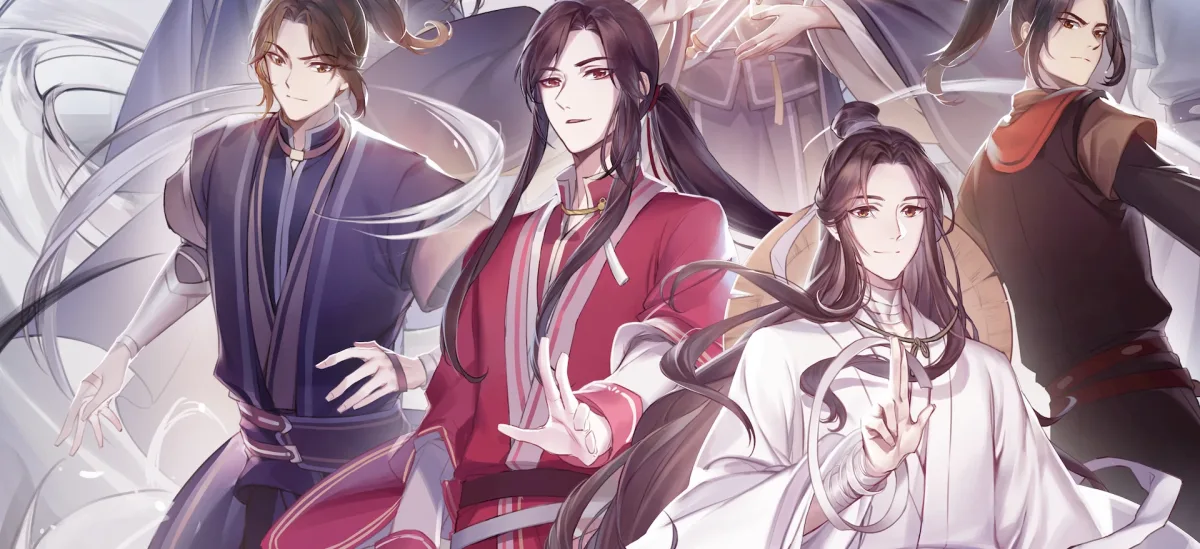
The strongest sequences use color and architecture to make a spiritual condition legible. Temples, deserts and ceremonial spaces carry histories before the exposition catches up. Fabric and hair movement give even stationary conversations a sense of ritual. Action is readable, but rarely the primary attraction.
Occasional polish differences are visible between showcase scenes and connective material. The larger limitation is not raw animation quality; it is the density of information the adaptation must place around each mystery. Beautiful staging can make a rushed explanation feel smoother, but not necessarily clearer.
Donghua versus novel and manhua
The donghua offers voice, music and timing, making it the most accessible first encounter for many viewers. The novel supplies the richest internal perspective and historical cause-and-effect. The full-color manhua turns STARember’s visual interpretation into the main attraction, but its release status and availability should be checked separately.
These versions are not interchangeable chapter containers. A viewer can enjoy the animation without completing the novel, but reading the source changes how earlier gestures and political references register. Choose based on the experience you want, not a belief that one medium invalidates the others.
Who should watch it?
- Watch if emotional attentiveness matters more than constant combat.
- Watch if supernatural investigations and courtly fantasy appeal to you.
- Expect to look up a title or faction occasionally if you are new to xianxia conventions.
- Skip if you need every world rule explained before a scene asks for emotion.
Where to watch legally
Crunchyroll maintains an official Heaven Official’s Blessing series page with licensed audio and subtitle information. Its catalog varies by territory, so confirm which seasons and languages are playable in your country. An accessible title page does not guarantee identical episodes in every region.
Case structure versus relationship structure
The supernatural cases give Xie Lian somewhere practical to direct his compassion. A haunting is rarely only a monster problem; reputation, neglected grief or institutional convenience determines whose pain becomes visible. The cases are most effective when that moral pattern and the central relationship advance together.
Compression creates trouble when a case needs several historical identities before its emotional question is clear. The animation can make the final image beautiful while a first-time viewer is still sorting titles. That is a pacing weakness, not proof that the underlying story lacks coherence.
What the voice performances add
Xie Lian’s composure depends on tiny changes in hesitation and humor. Voice performance makes the difference between passive gentleness and someone deliberately choosing not to answer contempt with contempt. Hua Cheng’s ease similarly needs warmth beneath confidence or devotion can sound like mere certainty.
Dub preference is personal, but language availability should be verified by season and region. Sampling one scene in Mandarin and a licensed dub is more useful than treating “original is always better” as criticism. The strongest track is the one that lets a viewer hear those behavioral distinctions.
Is two-season investment worthwhile?
Yes if the appeal is Xie Lian and Hua Cheng learning the shape of one another’s trust. The adaptation provides a satisfying sequence of cases and relationship movement even though it does not complete the source novel’s enormous history.
No if “complete” means every past event and final resolution in animation. The donghua is an ongoing adaptation experience, not a compressed replacement for all novel volumes. Entering with that expectation prevents the end of an available season from feeling like a broken promise.
Season-to-season clarity
The second season assumes viewers remember divine titles, prior cases and the emotional implications of Hua Cheng’s identity. Rewatching the final part of season one is more useful than starting with a lore encyclopedia, because the adaptation communicates relationships through performance as much as terminology.
Visual confidence remains high, but exposition pressure increases as the world widens. A viewer who understood the first season emotionally but not politically is not alone. The most productive response is to track Xie Lian’s current obligation and allow older history to become clearer when the story returns to it.
Frequently asked questions
Is Heaven Official’s Blessing a BL donghua?
It adapts a danmei novel centered on Xie Lian and Hua Cheng. The animation expresses their bond through devotion, framing and subtext rather than reproducing every level of novel detail.
Should I read the novel first?
No. The donghua works as an introduction. Read the novel first only if dense lore and internal context are more important to you than discovery through animation.
Is it connected to Mo Dao Zu Shi?
They share an author, Mo Xiang Tong Xiu, but have separate worlds, characters and continuities.
Continue reading
Continue with Heaven Official’s Blessing manhua review, Mo Dao Zu Shi manhua review, or Donghua reviews.
Sources and verification
- Crunchyroll — primary source
Official platform · accessed 26 Aug 2026