Verdict and review scope
This review covers the first two main seasons and the Bridon Arc available through official releases, without revealing case outcomes or late identity information.
Link Click succeeds because time travel is never just a puzzle mechanism. A photograph contains a person’s limited knowledge, unfinished relationships and one moment that cannot be touched without changing everything around it. The series makes supernatural power feel intimate before it makes it spectacular.
Quick facts
- Format: original Chinese 2D donghua created for Bilibili.
- Premise: Cheng Xiaoshi and Lu Guang enter photographs to fulfill clients’ requests under strict rules.
- Genres: drama, supernatural thriller and mystery.
- Official international platform checked: Crunchyroll, with subtitles and dubs varying by region.
- Content warnings include violence, suicide and other distressing material on the official page.
A rule system built around temptation
Cheng Xiaoshi can inhabit the perspective of the photographer; Lu Guang provides guidance based on what the image’s timeline reveals. Their central instruction is restraint. The power is useful precisely because violating that restraint feels morally irresistible.
The rules are understandable enough for tension but not so mechanical that the drama becomes a spreadsheet. Occasional ambiguity appears when the thriller expands, yet the strongest cases ask an emotional question before a technical one: what promise would make someone risk the future?
Why the ordinary cases matter
Early stories focus on work, family, friendship and regret. They build empathy without requiring a world-ending threat. A meal or message can acquire enormous weight because the viewer knows the moment is already part of someone’s past.
This case structure also teaches consequence. When the larger plot becomes more serialized, the audience has already learned that unnamed people are not disposable scenery. The thriller’s stakes feel human because the series practiced attention at a smaller scale.
Cheng Xiaoshi and Lu Guang
The partnership works through asymmetry. Cheng acts through emotion and proximity; Lu Guang tries to preserve distance and sequence. Neither position is sufficient. Compassion without control can cause harm, while control without disclosure damages trust.
Their conflict is more persuasive than a simple impulsive-versus-calm pairing because each method contains fear. Later revelations complicate that balance, but the emotional foundation remains the need to protect another person without deciding everything for them.
Direction, editing and music
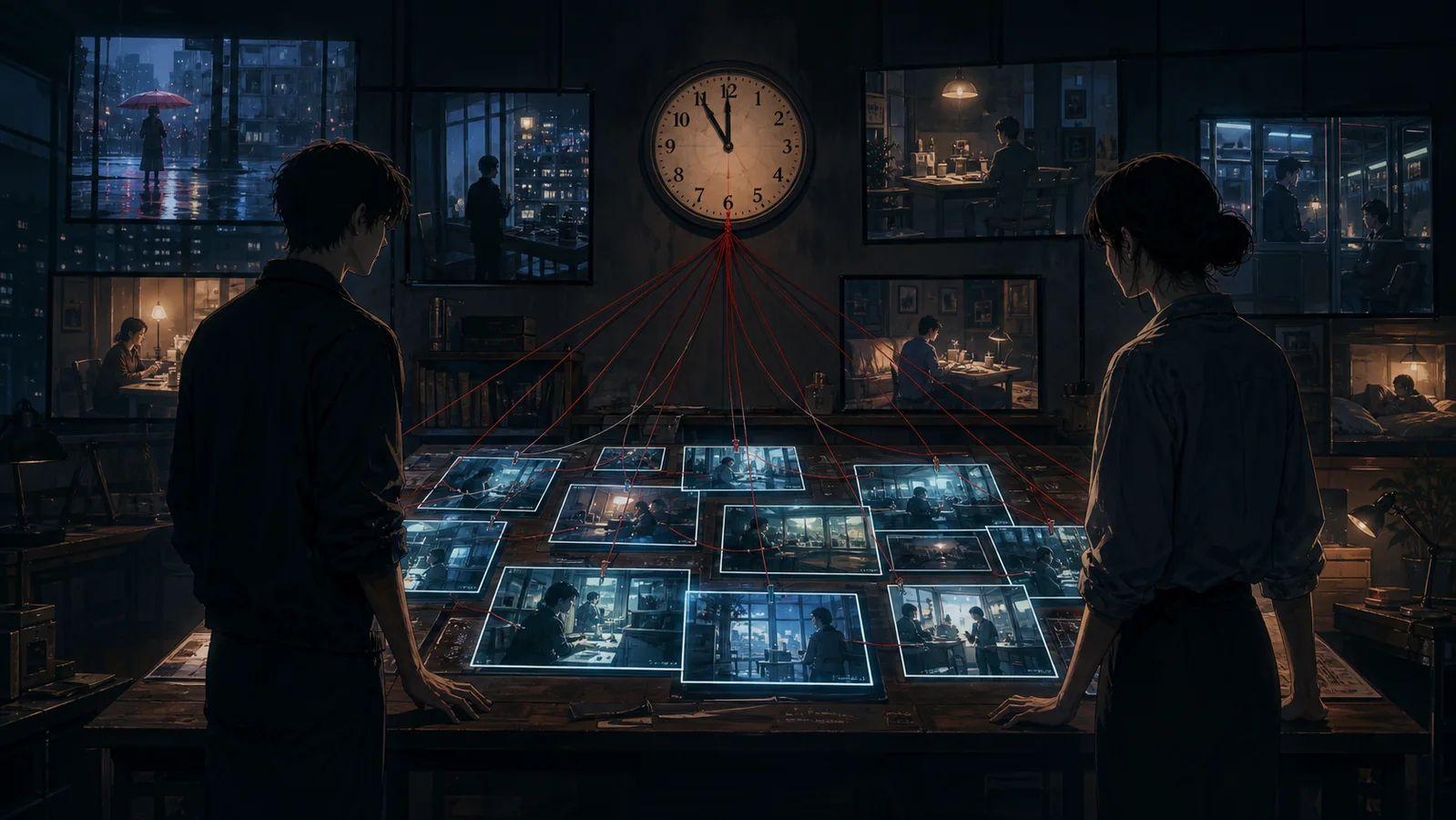
The visual direction uses photographs, reflections and repeated framing to distinguish memory from present action without always changing the palette. Editing can turn a familiar image into evidence by altering context rather than adding exposition.
Music and end-of-episode transitions are especially effective at converting resolution into unease. The series sometimes leans too hard on the cliffhanger cut, but the best endings reveal that an emotional choice has changed the shape of the mystery.
Where the thriller strains
As the conspiracy expands, rules and identities carry more narrative weight. The show’s humane case writing can be squeezed between reversals designed to preserve weekly suspense. Some viewers will miss the self-contained intimacy; others will welcome the larger architecture.
Villainous pressure is effective when it targets the partners’ ethical weakness. It is less effective when shock temporarily substitutes for motive. The series recovers whenever it returns from abstraction to the cost carried by one person.
Accessibility for new donghua viewers
Link Click is one of the easiest donghua recommendations for viewers who do not want cultivation terminology or 3D fantasy. Its modern setting, compact central power and strong official subtitles reduce the entry barrier.
Watch in release order and avoid character searches. Search snippets and thumbnails reveal information that the series treats as mystery. The Bridon Arc belongs after the earlier seasons, not as a standalone introduction.
Who should watch it?
- Watch for emotionally grounded time travel, friendship and case-based drama.
- Watch if consequences matter more than a perfectly hard science-fiction system.
- Skip if cliffhangers and delayed explanations feel manipulative.
- Use content advisories if suicide, grief or violence requires preparation.
Time travel as an ethical problem
The partners rarely face a neutral optimization puzzle. Information belongs to someone, intervention carries consent problems, and a client’s stated request may not express what the affected person would choose. The supernatural premise creates access without automatically creating moral authority.
Lu Guang’s rules protect sequence but can also hide emotional cost. Cheng Xiaoshi’s empathy restores that cost but can endanger everyone. The show’s ethical tension comes from refusing to make either impulse sufficient on its own.
The case structure and the serialized mystery
Self-contained cases provide closure and variety; the larger mystery provides momentum. Season one balances them particularly well because each ordinary life teaches a rule that later suspense can exploit. As serialization increases, the show gains conspiracy energy and loses some breathing room.
That is not simply decline. Longer arcs allow consequences to compound and the partnership to become the subject rather than the observing tool. The trade works when a revelation deepens an existing choice; it strains when another withheld identity exists mainly to power the next cliffhanger.
Dubs, subtitles and title grouping
Crunchyroll lists multiple audio tracks and subtitle languages, but availability varies by territory. The Mandarin performance is the original reference; dubbed editions can be useful for accessibility without changing the production’s identity as donghua.
Platforms may group specials or the Bridon Arc differently. Follow official episode titles and release announcements instead of assuming every item labeled “season” is interchangeable. Search results contain major spoilers, so the platform playlist is safer than a general web search.
Final verdict
Link Click is a thriller with a conscience. Its rules can bend under the needs of a growing mystery, but its emotional logic remains unusually strong: the past is not valuable because it can be fixed; it is valuable because people were alive inside it. That idea makes the series accessible, painful and difficult to stop watching.
Frequently asked questions
Is Link Click anime or donghua?
It is an original Chinese donghua produced for Bilibili. International platforms may place it in an anime catalog for navigation.
What is the watch order?
Begin with the first main season, continue through season two, then follow the officially labeled Bridon Arc and subsequent releases. Platform grouping can vary, so compare episode titles.
Where can it be watched legally?
Crunchyroll carries Link Click in supported regions with multiple audio and subtitle options. Availability can change by country.
Sources and verification
- Crunchyroll — primary source
Official platform · accessed 24 Aug 2026 - Link Click official site
Official source · accessed 24 Aug 2026