The Gamer is a good first system manhwa if you enjoy discovering how abilities work. Solo Leveling makes the power climb easier to follow, while Pick Me Up puts a harsher question first: what happens when you are the game unit, not the player? For a power with a dangerous activation condition, try SSS-Class Revival Hunter.
System manhwa use explicit game-like rules: quests, levels, skills, status messages or rewards that characters can respond to. A detailed magic system alone does not qualify. The recommendations below focus on what the interface makes someone do, who gets to use it and what happens when its demands become a problem.
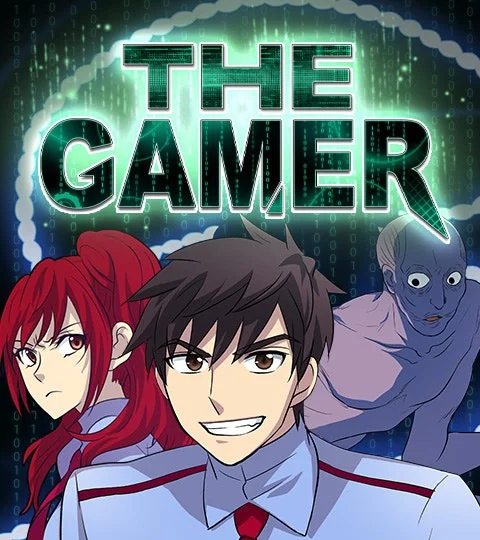
Compare the mechanism, not the number of status windows
| Comic | The central mechanism | Who has the advantage? | Best fit |
|---|---|---|---|
| The Gamer | Real life is experienced through a game-like ability. | A newcomer learning to use the interface. | Experimenting with skills and progression. |
| Solo Leveling | Personal quests and advancement change one hunter’s prospects. | Jinwoo has a path ordinary hunters do not share. | A focused weak-to-strong journey. |
| QUESTISM | Prompts offer rewards within school conflict. | Suhyeon benefits, but the demands keep growing. | Social status, bullying and confrontations. |
| Omniscient Reader | Survival scenarios arrive inside a story the protagonist knows. | The reader who recognizes the setup. | Rule interpretation and an ensemble. |
| SSS-Class Revival Hunter | Copying a skill carries a death condition; a second ability enables return. | A hunter learning how two powers interact. | Costly retries and difficult choices. |
| Pick Me Up | A gacha player becomes a low-ranked hero in another player’s roster. | The person controlling the roster holds power over the units. | Party survival rather than effortless solo wins. |
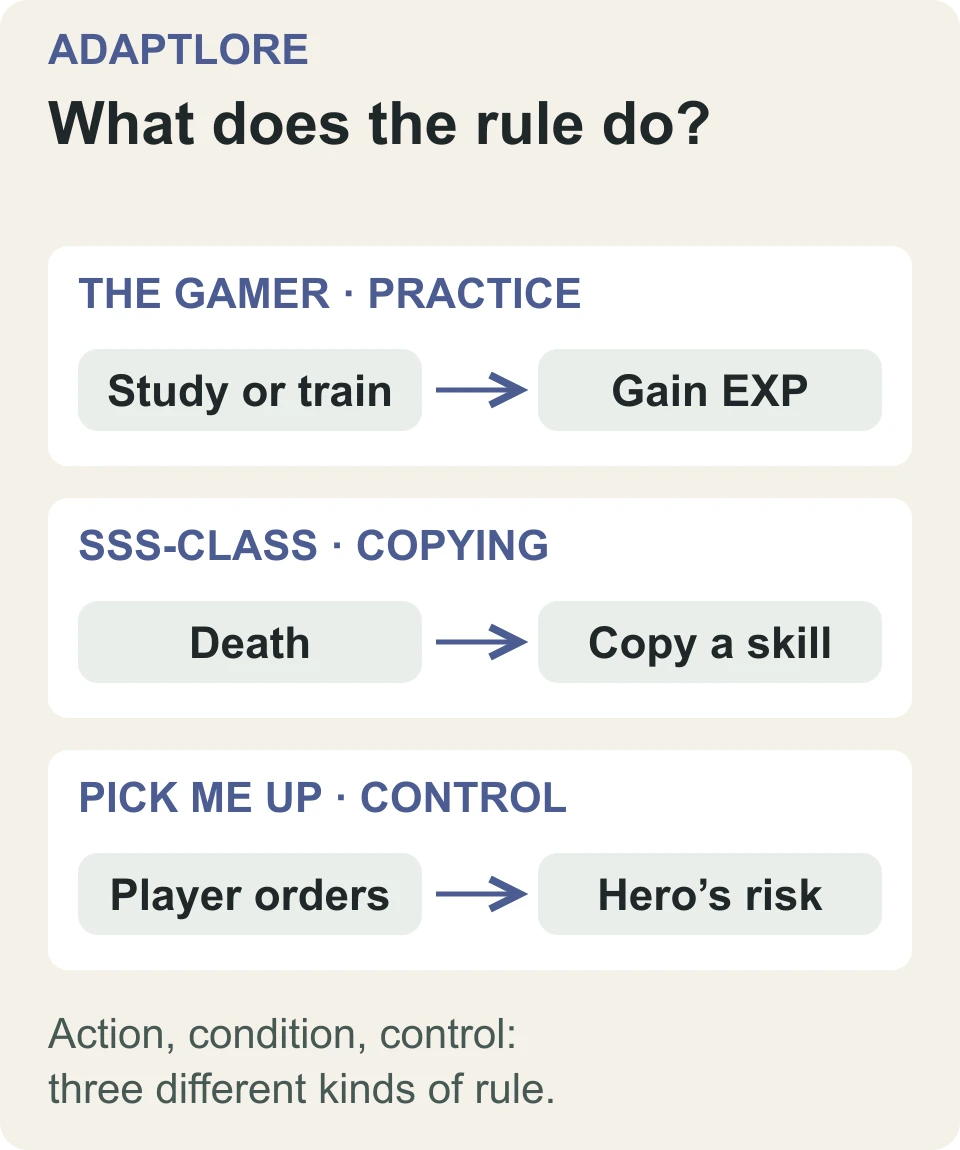
1. The Gamer: make learning the interface part of the fun
Jihan starts experiencing life as if it were a video game. That is the immediate promise of The Gamer on WEBTOON: familiar surroundings become a place to discover capabilities that other people do not perceive in the same way.
The first episode makes the rule tangible: working out earns experience, and studying does too. The panels put exercise and schoolwork beside visible progress notifications. Jihan also complains about having gained only one level. The feedback is immediate; the climb is not.
Jihan can now test a routine instead of guessing whether it helps. A workout and a study session both produce feedback, but neither skips the work. The appeal is in that small, repeatable experiment: do something, see the result, work out what to improve next.
WEBTOON lists the comic as completed. It is worth sampling if mechanics and experimentation appeal to you; less so if you usually skim ability explanations to get back to combat.
2. Solo Leveling: the system singles out one vulnerable hunter
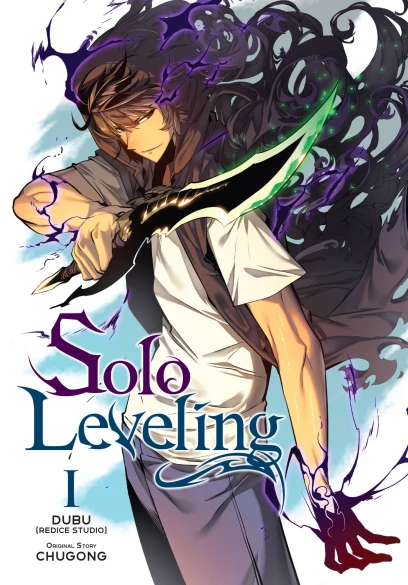
Jinwoo begins as a hunter who struggles to survive, not as a high-level player inspecting a finished build. His unusual opportunity gives him a route to improve that sets him apart from the world around him. The English comic is published on Tapas.
The system does more than announce that he has become stronger. The official synopsis for comic volume 2 describes the hospital aftermath, strange messages, daily quests and unfamiliar dungeons. Those demands turn his recovery into a new sequence of tasks rather than a return to his old routine.
The appeal is unusually easy to track: a person who could barely get through a raid is being given ways to change that position. You can follow the transformation without treating every side character as another player using an identical interface.
It is the first choice for a clean individual progression arc. Readers who mainly want a party to learn a shared ruleset together will get a different emphasis. Our Solo Leveling review looks at that trade-off in more detail.
3. QUESTISM: the quest log follows you into school
Suhyeon wants his life to work more like a game. When a quest prompt appears, it offers an escape from his miserable school situation. The official QUESTISM page connects that offer to bullying and rewards, then to increasingly demanding quests.
The first episode’s quest window asks him to apologize to his mother, with one gold card offered as the reward. That small domestic task explains the bargain more clearly than a promise of bigger fights: the system specifies an action, tracks completion and offers something he wants.
Compare that with The Gamer’s experience from study and exercise. Here the immediate question is whether Suhyeon will do what a particular prompt asks, not simply how much practice he can fit into a day. The premise then raises the demands. If you like rewards that draw a character into further obligations, this is the school-set option to try.
Expect school violence and struggles over status. This is not a gentle story about earning experience points for finishing homework, and the real-world setting does not remove the fantastical power escalation.
4. Omniscient Reader: recognize the scenario, then decide what to do
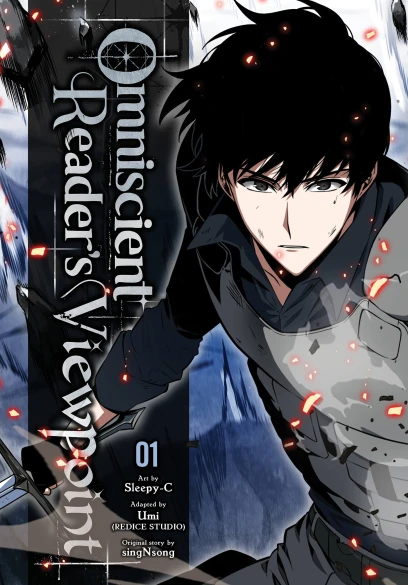
Dokja has spent years reading a web novel that suddenly becomes reality. Omniscient Reader on WEBTOON gives him an information advantage inside a world that now subjects people to its survival framework.
What sets it apart from Solo Leveling is the source of that advantage. Dokja is not simply receiving a private improvement path. He can recognize situations and people from the story, then decide how to intervene.
Reading the situation becomes part of the action. Dokja’s knowledge is only useful if he can turn it into a decision while other people are panicking, acting on incomplete information or pursuing different aims. A higher combat statistic would not answer all of those problems.
There is more to keep track of than in a tightly focused solo power climb. The Omniscient Reader’s Viewpoint review is a useful next stop if the larger cast and layered premise sound more interesting than a sequence of personal upgrades.
5. SSS-Class Revival Hunter: two powers, one uncomfortable interaction
The first ability copies a skill from the person who kills its holder, as the comic volume 1 synopsis explains. It is not a free “take any power” button. Being killed by the Flame Emperor supplies the return-through-time ability described on the official Tapas page.
Keep those two functions separate. Copying explains how he obtains an ability; returning changes what death means afterward. Combining them opens possibilities that neither description captures on its own.
The condition is the catch. Receiving a powerful skill sounds enviable until you have to consider the experience required to acquire it. That uneasy exchange makes the ability worth discussing beyond its place on a power-ranking chart.
Repeated death and self-destructive behavior make this a heavier recommendation than a cheerful skill-collection fantasy. Look for SSS-Class Revival Hunter on the licensed English platform; alternate names can make the same comic appear to be a different series.
6. Pick Me Up: the interface belongs to somebody else
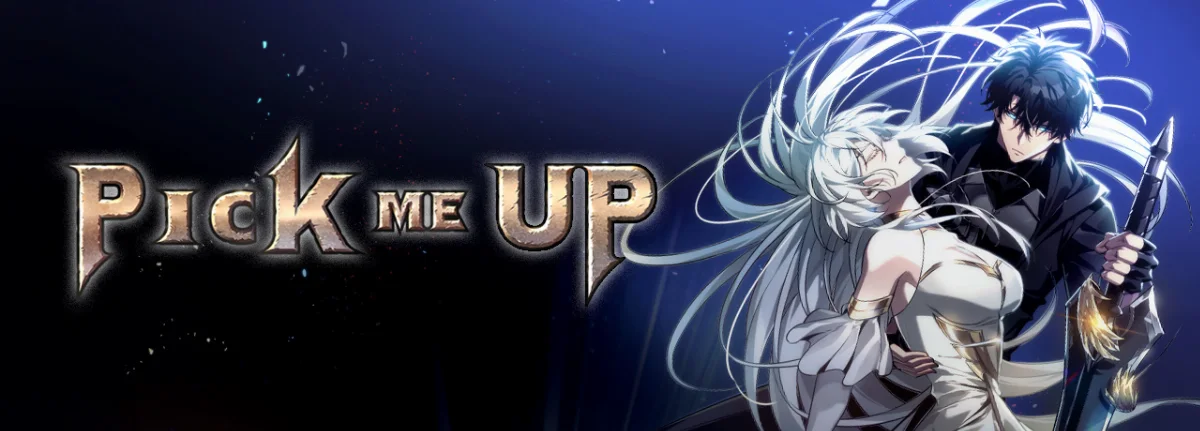
An expert gacha player finds himself inside the game as a low-ranked hero. In Pick Me Up on Tapas, the crucial distinction is between the person managing the roster and the characters inside it. The protagonist has crossed from one side of that interface to the other.
The rules create an unequal relationship: being able to understand an order is not the same as being able to cancel it. Raising a character’s rank operates inside that relationship; it does not by itself make the character the account owner. A stronger unit and a free agent are different things.
Jinwoo’s interface gives him a route forward; this one leaves the hero subject to a player’s decisions. Someone else can value a useful result more than the unit sent to obtain it. That imbalance is what makes Pick Me Up’s system oppressive even when its rules are understandable.
Which one should you start tonight?
Choose The Gamer if you want to poke at the mechanics. Choose Solo Leveling if you want a clear transformation. Choose Pick Me Up if the rules should feel dangerous to live under.
For a school setting, QUESTISM is the distinctive option. For interpreting a complicated situation, take Omniscient Reader. For a skill interaction whose cost cannot be ignored, take SSS-Class Revival Hunter. There is no need to begin all six to work out which flavor suits you.
Does “system” mean the protagonist will become invincible?
No. It describes how the story presents rules and incentives, not a guarantee of eventual power. A system may be a personal tool, a shared survival structure or a source of control over the hero.
Likewise, a completed comic is not necessarily free to read in full. Use the official opening samples and check the current unlock model before buying chapters. Our guide to reading manhwa legally explains how to distinguish the comic edition, its platform and its access options.