Verdict
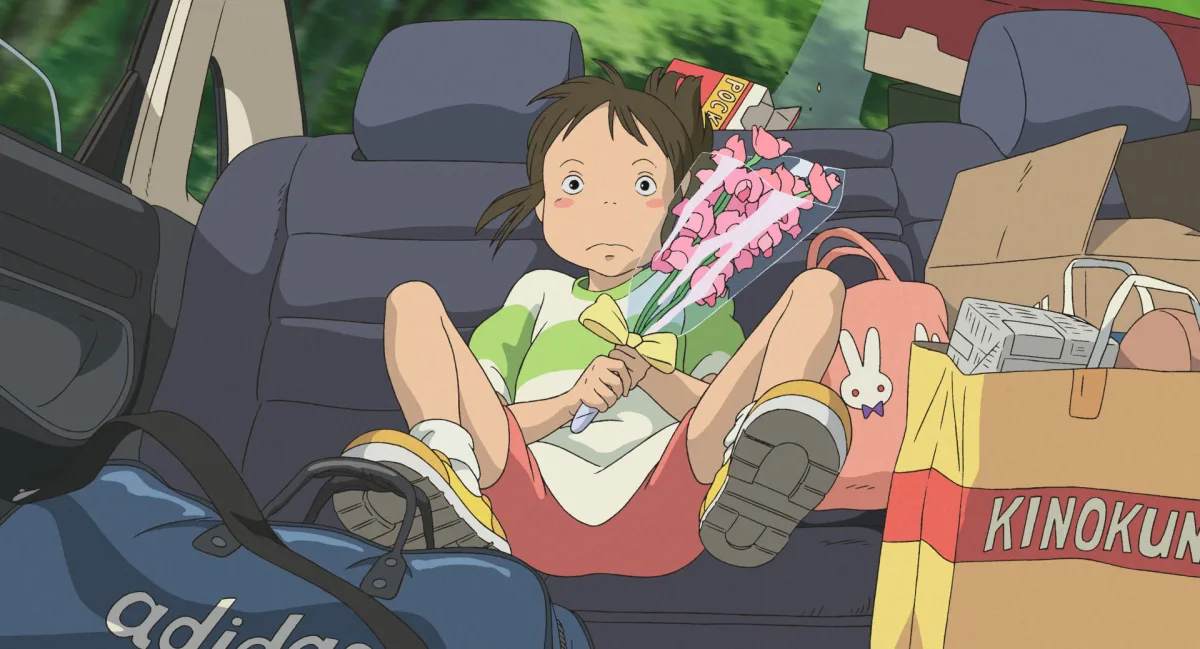
Spirited Away begins with Chihiro complaining in the back seat and then asks her to survive a world where adults’ appetites have immediate consequences. Her growth is not a hidden power awakening. She learns names, completes unpleasant work, asks better questions and keeps moving while afraid. That makes the film accessible to children without simplifying courage into fearlessness.
The bathhouse endures because it operates before Chihiro arrives and will continue after she leaves. Workers have routines, hierarchies and private motives. Spirits are guests, hazards and customers rather than a single species of moral lesson. The world feels deep because it does not pause to prove its depth.
Scope and viewer guidance
- Runtime: Studio Ghibli lists approximately 125 minutes.
- Written and directed by Hayao Miyazaki; music by Joe Hisaishi.
- Spoilers: setup and thematic discussion only; no final resolution.
- Younger viewers may be upset by parental transformation, large creatures and sustained separation anxiety.
Chihiro grows through work
Work in the bathhouse is not presented as automatic virtue. It is exhausting, hierarchical and sometimes unfair. What it gives Chihiro is participation. She stops being moved from room to room and begins making choices that affect other people.
Her politeness also changes meaning. At first it is hesitant obedience; later it becomes attention with boundaries. She can thank someone, refuse a gift and recognize danger without turning every strange being into an enemy.
No-Face, appetite and interpretation
No-Face reflects the environment around him, but he is not a tidy symbol that can be solved once. In the bathhouse, attention is transactional and appetite is rewarded, so his gifts expand into demand. Around Chihiro, who does not want what he offers, a different relationship becomes possible.
The film invites readings about consumption, loneliness and social performance without collapsing into one official equation. Its images remain alive because metaphor and character behavior are allowed to coexist.
Visual storytelling, sound and atmosphere
Miyazaki gives transitional moments full weight: a train moves across water, food is prepared, a boiler room breathes. These pauses are not decorative delays. They let Chihiro and the viewer absorb a changed emotional condition before the next demand arrives.
Joe Hisaishi’s score supports wonder without instructing every reaction, while environmental sound makes labor and machinery tactile. The hand-drawn character acting keeps tiny shifts readable even beside enormous spirits.
The visual scale never makes Chihiro irrelevant. Doorways are too large, corridors are crowded and meals are excessive, yet the camera keeps returning to what she notices and chooses. Spectacle is therefore measured against a child’s attention instead of existing as a separate showcase.
Even silence has narrative work to do: it gives fear enough room to become observation rather than panic.
Who should watch it?
- Watch it as a family if adults are ready to discuss frightening transformation and separation.
- Watch it if you prefer fantasy rules learned through behavior instead of exposition.
- Do not expect a conventional villain battle or every creature to receive a lore entry.
- Rewatch it later: the film changes as the viewer notices more of the workers and adults around Chihiro.
Official film information and images
Studio Ghibli’s official work page provides the production credits, 2001 release date, approximate runtime and a set of film stills with the studio’s usage note. Streaming rights differ by territory, so confirm a licensed local service on the day you watch.
Why the parents matter after they disappear
Chihiro’s parents spend much of the film unavailable, but their opening behavior establishes the danger: confidence without attention. They enter, consume and assume payment will solve any boundary they ignored. Chihiro begins fearful, yet she is the only person in the family noticing that the place is asking them to stop.
Her growth is therefore not a reversal into adult certainty. She becomes capable by preserving the attention the adults lacked. The film respects a child’s unease as information while also showing that fear cannot make every decision for her.
The train scene and the value of transition
The journey across flooded land is famous because it refuses the usual pressure to explain or escalate. Chihiro has completed urgent work but has not emotionally arrived at the next choice. Anonymous passengers, distant houses and the steady sound of travel create room for consequence.
That patience is difficult to imitate. A slower scene is not automatically profound; this one carries changed relationships and an uncertain destination. It demonstrates why the film’s quieter passages are structural, not ornamental pauses between creatures.
What a rewatch reveals
Children often remember transformation, No-Face and the fear of losing parents. Adult viewers may notice labor hierarchy, exhausted workers, transactional hospitality and the ways Yubaba separates a person from a name. Neither reading cancels the other.
A rewatch also shifts attention away from solving symbols. Minor workers make compromises, Zeniba’s home offers another model of community, and Haku’s help contains its own vulnerability. The film grows because it distributes meaning across behavior rather than hiding one answer behind the ending.
Is the film too frightening for a first Ghibli?
The answer depends less on animation experience than on the child. Parental transformation, separation and enormous bodies can be more upsetting than conventional battle violence because Chihiro has no stable adult protection. Other children find her practical recovery reassuring.
Adults should avoid promising that nothing scary happens. Explain that Chihiro remains active and that the film returns from frightening images rather than dwelling on punishment. If a child is highly sensitive to parents disappearing or changing, My Neighbor Totoro may be a gentler first Studio Ghibli film.
Frequently asked questions
What age is Spirited Away suitable for?
There is no universal age. Many school-age viewers handle it well, while others find the transformed parents, spirits and separation frightening. Familiar adult support matters more than a simple number.
What does No-Face represent?
He can support readings about loneliness, appetite and environmental influence, but the film does not reduce him to one fixed code.
Is Spirited Away based on a book?
Studio Ghibli credits Hayao Miyazaki with original story, screenplay and direction; it is not presented as an adaptation of a prior novel.
Continue reading
Continue with Fantasy anime guide, Anime reviews, or Anime guides.
Sources and verification
- Studio Ghibli — primary source
Official source · accessed 26 Aug 2026