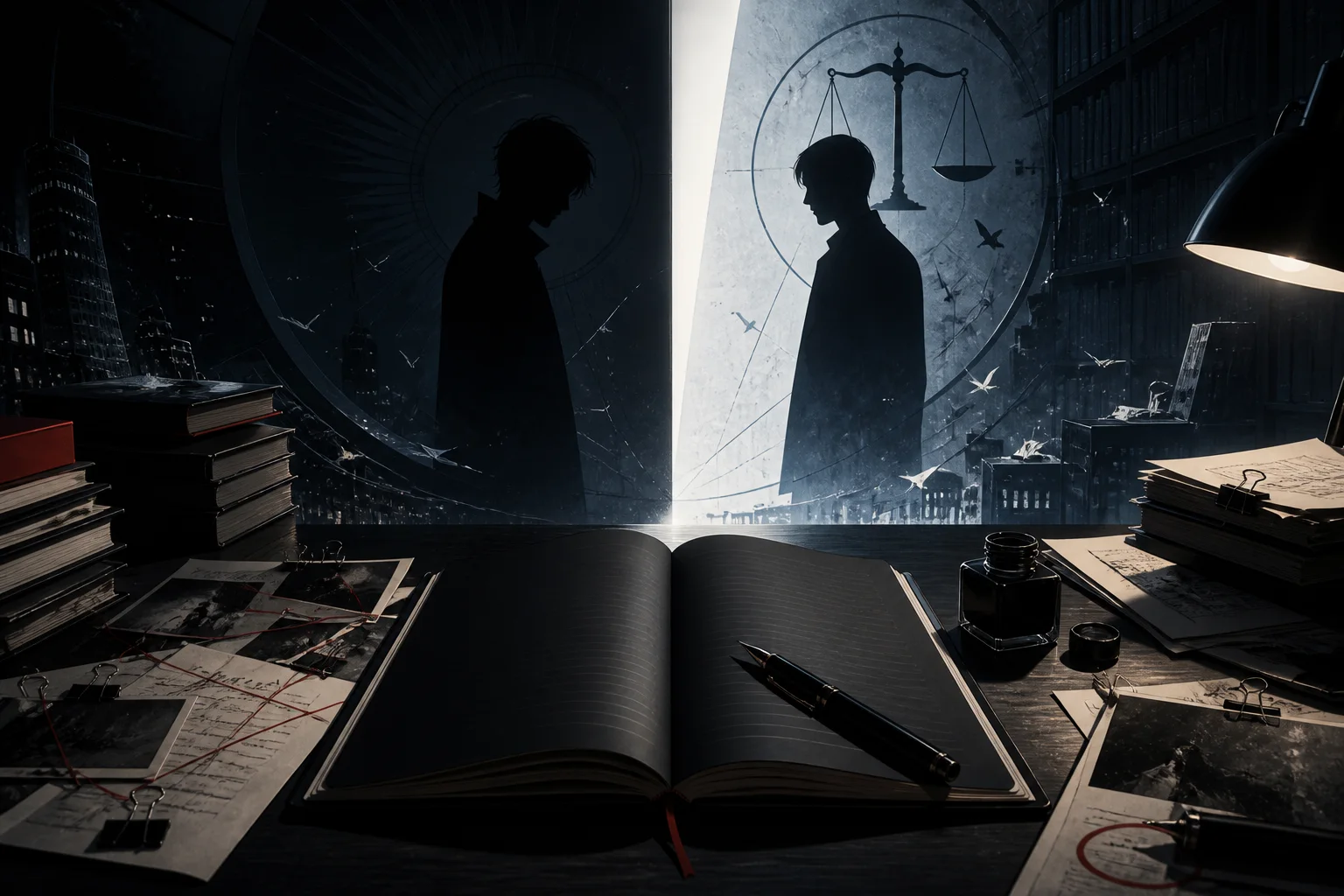
Verdict: an exceptional hook that becomes a real argument
Death Note is famous for a premise that can be explained in one sentence: a notebook allows its owner to kill anyone whose name and face are known. What keeps the anime from becoming a chain of clever murders is the way it turns that power into a conflict about certainty. Light Yagami does not merely use the notebook; he builds an identity around the belief that intelligence gives him the right to judge.
The series is strongest when that certainty meets resistance. Detective L approaches the killings as a problem that can be narrowed through observation, provocation and controlled risk. Their rivalry works because neither man is simply waiting for the plot to reveal a clue. Each decision changes what the other side believes, so even an ordinary conversation can function like a tactical move.
If that information-driven suspense is what you want, compare this review with our thriller anime guide. Death Note is the fastest hook there, while Monster and Odd Taxi reward different kinds of patience.
Death Note at a glance
| Question | Answer |
|---|---|
| Best quality | A clear rule system turned into psychological strategy |
| Biggest weakness | The final stretch loses the first rivalry’s intensity |
| Pacing | Fast and compulsive early; more uneven later |
| Spoiler level here | Mild premise discussion; no major outcome revealed |
| Best for | Viewers who enjoy mind games, antiheroes and moral pressure |
The notebook rules are dramatic machinery, not trivia
A weaker version of this story would add rules whenever the writer needed an escape. Death Note usually does the opposite. It states a limitation, lets Light or L test it, and then makes the consequence visible. Because the audience understands enough of the system to form a prediction, a reversal feels earned rather than magical. The rules also expose character: Light treats every constraint as a challenge to dominate, while L treats uncertainty as something to measure.
That structure explains why the anime is so easy to binge without feeling empty. Episodes end on a question that has been prepared inside the story, not on a random interruption. The result is propulsive, but it also gives viewers something concrete to debate: whether a plan was ethical, whether it was avoidable and what the planner sacrificed to remain in control.
Light and L are compelling because the story does not confuse intelligence with wisdom
Light is charismatic, disciplined and frighteningly adaptable. Those strengths do not make his conclusions correct. The anime repeatedly shows how quickly a mission described as public safety becomes inseparable from ego, secrecy and the need to win. L is not presented as a morally pure opposite. His methods are invasive and sometimes cruel, which keeps the conflict from collapsing into a simple hero-versus-villain chase.
The supporting investigators matter most when they force the two geniuses to operate inside institutions and relationships. The series is less successful with its female characters. Several are defined primarily by devotion, manipulation or narrative utility, and their intelligence is rarely allowed the same sustained space as the central men. That limitation is noticeable in a show otherwise fascinated by competing minds.
Direction, music and adaptation quality
Madhouse’s adaptation understands that pages of deduction need a physical rhythm. Camera angles, sharp changes in lighting and deliberately excessive gestures give thought a visual shape. The score moves between choral grandeur and nervous electronic tension, matching Light’s tendency to see his private decisions as history in the making. Some sequences are theatrical to the point of parody, but the confidence of the presentation is part of the appeal.
The animation is not built around constant spectacle. Its craft is in staging faces, rooms, screens and objects so that attention has a direction. That makes the occasional burst of motion more effective and allows the series to remain visually distinctive across a long run of conversations.
Where the anime loses momentum
Without revealing the turning point, the later portion replaces a uniquely charged relationship with a more distributed conflict. The logic remains understandable and several individual ideas are strong, but the emotional voltage drops. New participants have less time to become complicated, while the plot must work harder to recreate a tension that originally grew from two incompatible personalities studying each other.
This does not make the ending worthless. The final consequences are thematically consistent, and the complete story is preferable to a series that never commits to an outcome. It does mean that viewers who fall in love with the exact chemistry of the first major arc should expect a less elegant final approach.
Who should watch Death Note?
- Watch it if you want a complete thriller with an immediate premise and clear strategic rules.
- Watch it if you enjoy protagonists whose confidence is part of the danger.
- Watch it if long dialogue scenes work for you when every sentence carries tactical meaning.
- Skip it if manipulative antiheroes make it difficult for you to stay engaged.
- Be cautious if you need thoughtfully developed women; the series repeatedly falls short there.
Content and commitment
Death Note runs for 37 episodes and tells a complete story. It includes murder, suicide-related material, coercion, surveillance and psychological manipulation, but its violence is usually less graphic than its premise suggests. The more persistent discomfort comes from watching people become instruments inside someone else’s plan.
Frequently asked questions
Is Death Note still worth watching?
Yes. Its technology and fashion date the production, but the central questions about authority, surveillance and self-appointed justice remain sharp. The first major rivalry is still among anime’s most effective introductions to psychological suspense.
Does Death Note have a satisfying ending?
The ending is decisive and thematically appropriate, although the route to it is less strong than the opening half. Viewers are unlikely to be confused about what the story ultimately thinks of its central obsession with control.
Is Death Note suitable for a first anime?
Yes, especially for viewers coming from crime dramas or thrillers. It requires no knowledge of anime conventions. For a broader next step, use our anime guides to choose by genre and viewing commitment.
Sources and verification
- VIZ Media — primary source
Official publisher · accessed 25 Aug 2026