Is My Hero Academia worth watching?
My Hero Academia begins with a boy running toward danger before he has the power to survive it. That choice matters more than the later catalog of Quirks. Deku’s value is not that he secretly deserved inherited power more than everyone else; it is that his body moved to help when calculation said not to. The anime returns to that idea often enough to keep its best moments emotionally coherent.
In a society where most people have abilities called Quirks, the powerless Deku dreams of becoming a professional hero. All Might gives him a chance, and U.A. High School becomes the place where that dream has to survive training, competition and real danger.
That sincerity is the best reason to watch My Hero Academia. The victories matter because someone needs help, not simply because the next villain has a bigger power. It is an accessible entry into battle shonen, with a clear premise and characters whose fears are easy to understand. The tradeoff is patience: school interludes, repeated declarations of resolve and an increasingly crowded cast make it less focused than its strongest scenes suggest.
Deku and All Might give the spectacle a purpose
All Might gives Deku power, but also gives him an impossible image of self-sacrifice. Early training is compelling because ability does not equal control: every use forces Deku to confront a body, school and society unprepared for what he carries. The relationship works best when mentorship becomes mutual honesty rather than distant worship.
All Might’s smile does two jobs. It reassures the people who need him, and it hides the strain of being the person everyone needs. Deku sees the inspiring image first and the cost of maintaining it later. Their quieter scenes matter because heroism becomes something to learn together rather than a test of whether Deku can imitate an unbeatable man.
Deku’s habit of watching other people also makes him more interesting than a simple successor. Before he can overpower a problem, he has to notice a limitation, a frightened person or a useful detail. As his abilities grow, some solutions lose that close-up ingenuity. The emotional through-line survives, but viewers who prefer the resourceful beginner may miss how small and immediate his early problems felt.
The characters you stay for—and the ones left waiting
Bakugo is the difficult counterpart to Deku’s openness. His early bullying is ugly, and later vulnerability does not make it retroactively charming. His development becomes persuasive when self-awareness changes his behavior, especially his assumptions about talent and weakness. Whether that repair feels sufficient will depend partly on how strongly the opening alienated you.
Todoroki gives the school competitions a different kind of pressure: using an ability can mean confronting what a parent expects of him. That personal conflict makes an apparently straightforward contest about identity as well as winning. It is the kind of connection between power and character that the series handles particularly well.
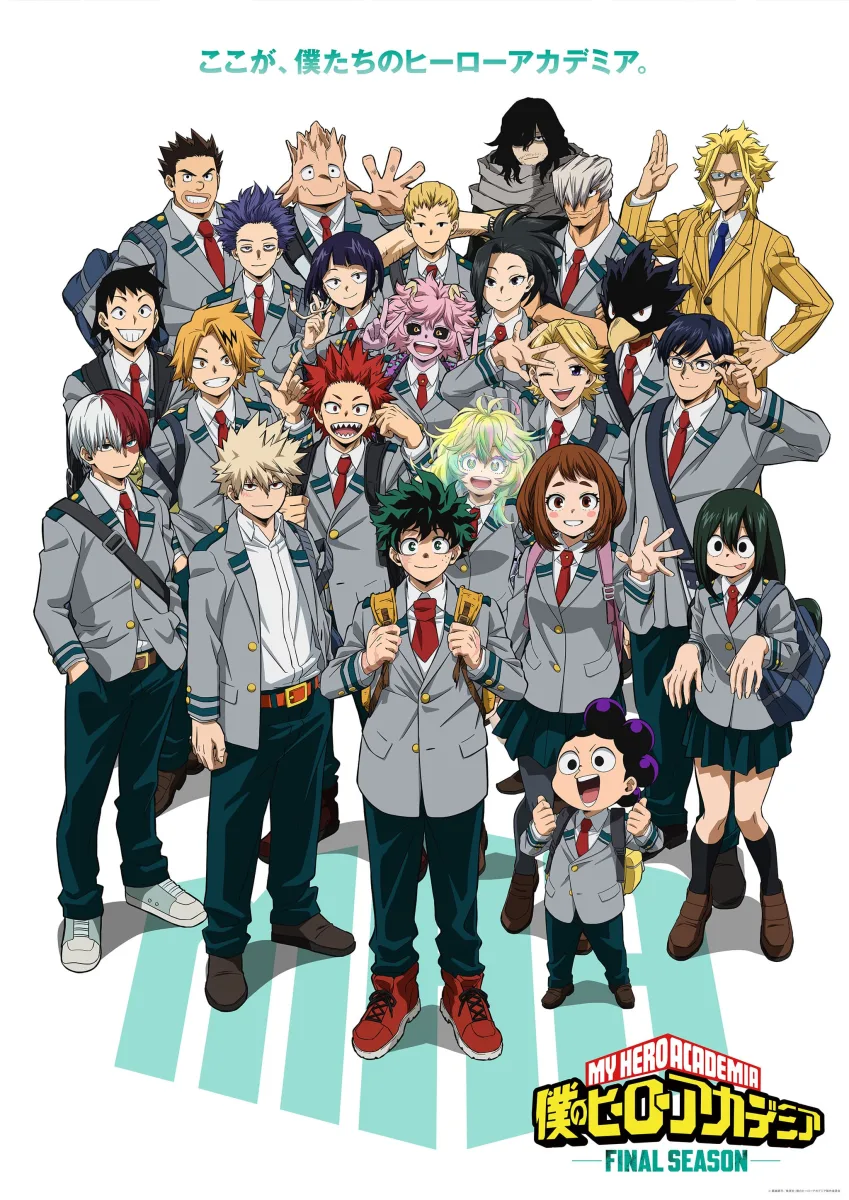
Class 1-A creates warmth and scale, but also a structural promise the anime cannot always keep. Several students have memorable abilities and almost no interior life. The ensemble feels strongest in cooperative problems where a minor skill changes the plan, not in crowd scenes that give everyone one reaction line.
From school competitions to a darker hero society
The early seasons benefit from a clean rhythm: a lesson introduces a limitation, an incident tests it, and classmates reveal different definitions of heroism. As the threat grows national, that classroom scale cannot remain untouched. The series becomes more serialized, more severe and less able to give every student an independent turn.
The larger story has something to gain from that change. A Quirk can become a career, a brand or the reason someone is rejected, and the villains expose damage that public heroism has not repaired. The anime gives those grievances emotional force without making every violent response defensible. Its social questions are often broader than its answers, though; some issues fade behind the central conflict before they receive much follow-through.
For viewers attached to the school setting, the loss of everyday class time can be as significant as the darker violence. Later scale does not mean more time with everyone. Watch for the central relationships and the changing demands of heroism, rather than expecting each student to receive an equally developed journey.
How the action, music and pacing hold up
The strongest fights have a task beyond knocking someone down: reach a person, protect an opening or buy enough time for another hero to act. That makes different Quirks useful in different ways. A supporting ability can change the plan, and a desperate movement can tell you more about a character than a speech about courage.
At its best, the anime brings those choices together through readable poses, forceful performances and music that makes a turning point land. The finish is less consistent between peaks. Static exchanges and repeated reactions can stretch an already familiar emotion, particularly when a large conflict needs to check in with many characters.
Pacing varies more than the premise suggests. Training and school culture can refresh the cast, then feel mistimed beside escalating public danger. Binge viewers may find transitions smoother than weekly viewers did, but the underlying unevenness remains.
Anime or manga?
Choose the anime if voices, sound and the release of a big action sequence are central to your enjoyment. Its strongest scenes benefit from being given a rhythm you cannot get from a still page. Choose Kohei Horikoshi’s manga if you prefer detailed line work and control over how quickly you move through recaps, reactions and transitions. The anime is the more immediately emotional route; the manga is easier to read at your own pace.
Before you start
- The main TV story is complete. Final Season ended in December 2025; the later “More” special adds an epilogue.
- Start with the first television season. The films are optional additions, not prerequisites for understanding the main plot.
- Expect bullying, serious injuries and increasingly sustained violence. The school premise does not make the entire run light viewing.
Streaming availability differs by region and season. Check the season list on a licensed service available where you live, including whether the epilogue and optional films are separate listings. A franchise page is not a guarantee that one subscription includes everything.
The bottom line
My Hero Academia earns its long commitment most convincingly when a character has to decide what helping another person will cost. It is less reliable at keeping its huge ensemble equally alive. If Deku’s earnestness, All Might’s burden and teamwork draw you in, the uneven stretches have a strong emotional destination. If those qualities leave you cold, bigger battles alone are unlikely to change your mind.
Frequently asked questions
Is My Hero Academia finished?
Yes, the main television story has ended. Final Season and the “More” epilogue belong to that conclusion; later franchise shorts do not mean the central story is still awaiting a finale.
Do I need to watch the movies?
No. Follow the TV seasons first. The films offer additional adventures and set pieces, but the central story does not depend on watching every one.
Is it suitable for beginners?
Yes, particularly if you like superhero stories and clear emotional stakes. Its length and darker later conflicts are bigger barriers than its power system.
Sources and verification
- My Hero Academia official anime site — primary source
Official source · accessed 26 Aug 2026