A spoiler-aware review of the story, characters, artwork and reading experience.
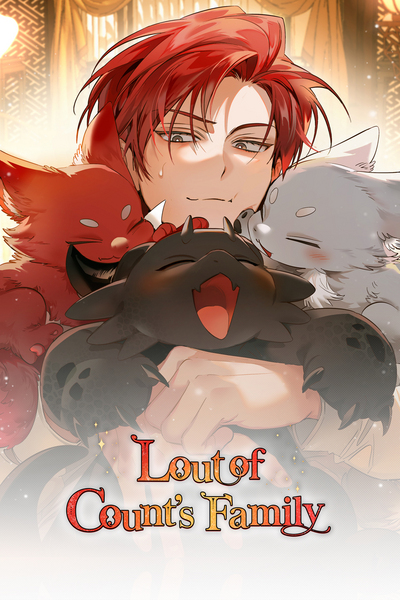
Cover image used for identification.The short verdict
Lout of Count’s Family begins with a joke common to isekai: a reader wakes inside a novel as someone destined to have a terrible day. Its longevity comes from the contradiction that follows. Kim Roksu, now Cale Henituse, insists that he wants an idle life while repeatedly spending money, information and his own safety to prevent other people from suffering.
The manhwa is not a rapid power climb. It is a slow accumulation of trust, obligations and political reach. Readers who enjoy watching a household become a coalition will find plenty to love. Readers waiting for a compact plot or constant one-on-one combat may wonder why every solved problem introduces three more names.
What is Lout of Count’s Family about?
Kim Roksu awakens in Birth of a Hero as Cale Henituse, the drunken noble who is supposed to provoke hero Choi Han and receive a brutal beating. Cale’s immediate goal is sensible: avoid the original confrontation, gather enough strength to remain safe and live comfortably away from the novel’s disasters.
His information changes events before he can retreat. Saving one person creates a relationship. Preventing one catastrophe exposes a larger threat. Cale keeps calling each intervention preparation for retirement, even as the collection of people depending on him begins to resemble a family.
Why Cale Henituse works as a protagonist
Cale is compelling because his self-description is unreliable in a consistent way. He calls himself lazy but prepares obsessively. He calls people useful while remembering what frightens them. He dislikes pain and nevertheless places himself where the cost can fall on him instead of someone more vulnerable.
The story rarely forces him to announce that he cares. Care appears through logistics: food, money, escape routes, information and the refusal to leave a rescued child without a future. That restraint makes his generosity feel more persuasive than a speech about friendship would.
Found family is the real progression system
Cale acquires ancient powers, but the more meaningful expansion is social. Choi Han, Raon, On, Hong, Ron and the wider group do not simply increase his combat score. They bring histories and needs that complicate his plan while making his life less empty.
The best scenes often happen after danger, when the household interprets Cale’s behavior more accurately than he would like. Their loyalty is funny because he believes he can still describe it as a temporary arrangement. It is moving because many of these characters recognize protection after living without it.
World-building that expands in layers
The opening focuses on a noble household and knowledge of future incidents. The world then grows through kingdoms, races, religious power, ancient forces and conflicts whose causes predate Cale’s arrival. This layered approach makes the setting feel larger than a game map unlocked one region at a time.
It also creates a cost. New factions arrive before every earlier name has become memorable. The manhwa sometimes moves from explanation to action quickly, leaving readers to reconstruct why a political connection matters. A glossary should not be mandatory, but rereading can improve later arcs.
Action favors preparation over duels
Cale is not designed to replace Choi Han as the cleanest fighter. He builds combinations: the right ancient power, ally, location and piece of information applied before an enemy understands the plan. The resulting battles are satisfying when preparation becomes visible.
This makes the series a good fit for readers who prefer team strategy to endless solo dominance. It also means some confrontations spend considerable time arranging the board. If tactical setup feels like delay, the pacing will test you.
The comedy comes from competing versions of Cale
Cale sees a practical coward pursuing comfort. His companions see a self-sacrificing commander who refuses praise. Outsiders often see a terrifyingly informed noble with resources appearing exactly where disaster will strike. The gap among those versions produces the most reliable humor.
The misunderstanding does repeat, but it develops consequences. Reputation attracts allies, enemies and responsibilities. What began as an accidental image becomes a political force Cale must manage.
Where the manhwa struggles
The cast becomes difficult to track. Characters, organizations and historical terms accumulate faster than every relationship can receive equal visual emphasis.
Cale’s denial can become repetitive. His insistence that he is not kind remains central to the joke, but veteran readers may wish his self-understanding advanced as quickly as everyone else’s.
Inner reasoning is compressed. The manhwa keeps the plot moving, yet some plans feel clearer in prose because the novel has room for Cale’s calculations and contextual memory.
The pace is deliberately long. This is not a short commitment with a single villain or destination. Its pleasure is cumulative rather than urgent.
Manhwa or novel: which should you read?
Start with the manhwa if visual clarity, character design and a lower initial commitment matter most. PAN4 and PING make the household immediately likable, and Raon’s presence benefits enormously from visual timing.
Choose the novel if you want more of Cale’s internal logic, political context and the scale of the original story. The best route for invested readers is often to sample the manhwa, then begin the novel from the start rather than jumping to a roughly corresponding chapter and missing adaptation differences.
Does Lout of Count’s Family have romance?
Romance is not the central engine. The story prioritizes found family, loyalty, adventure and political survival. Readers can interpret individual bonds in different ways, but anyone starting primarily for a developing canonical couple is likely to find the emphasis elsewhere.
Current publication status
When checked on 24 August 2026, Tapas listed 173 comic episodes and announced a hiatus after season four, with season five planned to follow. Tapas used the official English title Lout of Count’s Family and credited PAN4, PING and Yu Ryeo Han.
Lout or Trash of the Count’s Family?
They refer to the same work. Trash of the Count’s Family became the familiar fan-translated title, while Tapas and the Seven Seas novel edition use Lout of Count’s Family. AdaptLore uses the licensed title in the headline and retains the older name only as a search and identification synonym.
Who should read it?
Read it if you enjoy competent protagonists whose strength includes planning and emotional responsibility. It is especially suitable for readers who liked the household-building side of The Greatest Estate Developer but want less gag comedy and a broader fantasy conflict.
Skip it for now if you need a completed story, rapid romantic progress or a tightly contained cast.
Final verdict
Lout of Count’s Family understands that found family becomes meaningful through repeated material choices. Cale feeds people, equips them, anticipates danger and makes himself responsible while insisting that responsibility is merely efficient.
The manhwa occasionally loses detail while translating an enormous novel, and its comfortable patterns can repeat. Even so, the central contradiction remains durable: a man trying to avoid being a hero keeps building a life in which walking away would be impossible. That earns a strong 4.3/5.
Frequently asked questions
Is Lout of Count’s Family worth reading?
Yes for readers who enjoy found family, strategic leads, team action and fantasy settings that expand gradually.
Are Lout of Count’s Family and Trash of the Count’s Family the same?
Yes. “Trash” is the widely recognized earlier fan title; “Lout” is used by the official English Tapas and Seven Seas editions.
Is the manhwa complete?
No. Tapas announced a hiatus after season four and said the comic would return for season five.
Where can I read it legally?
The official English comic is available on Tapas. Seven Seas publishes the original novel in English through its Siren imprint.
Official sources
- Tapas — primary source
Platform · accessed 25 Aug 2026