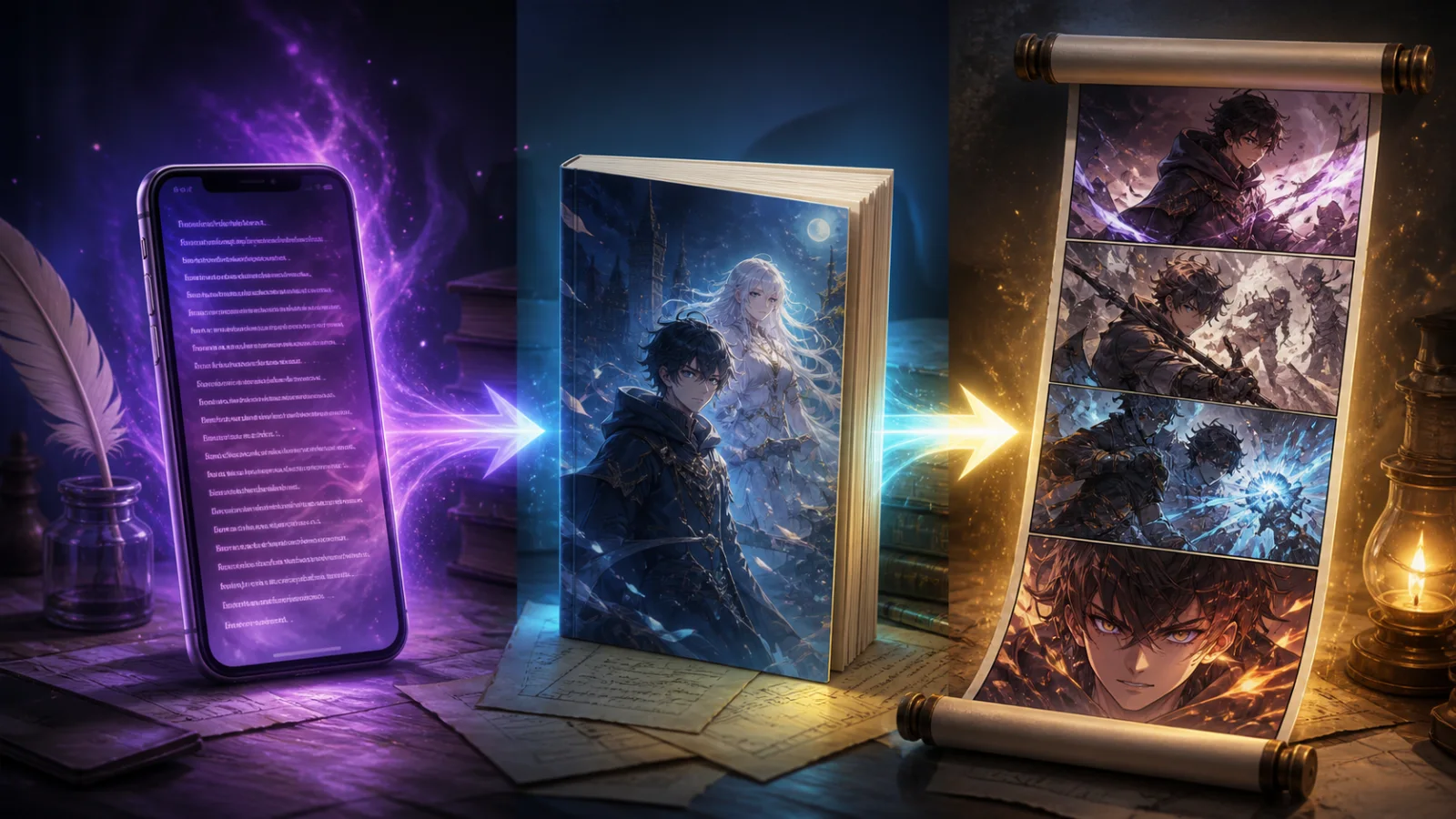
Web novel, light novel and manhwa at a glance
What is a web novel?
A web novel is fiction distributed primarily online. The decisive feature is the publication route, not the author's nationality, the genre or the presence of anime-style artwork. Many platforms are designed around serial reading: writers publish a chapter, readers follow the series, and another installment arrives later.
That chapter-by-chapter model can shape the writing. Web novels often need frequent hooks, reminders and visible progress because readers may encounter the story over months or years. But “web novel” does not mean unedited, amateur or free. A platform may commission originals, lock later chapters behind payment, or work with professional publishers.
What happens when a web novel becomes a book?
A publisher may reorganize chapters, rewrite scenes, commission illustrations and package the story into volumes. That printed or ebook edition is a separate edition, not simply the website copied onto paper. Plot details and numbering can diverge, so a reader should identify the edition before asking where to continue.
What is a light novel?
Light novel is best treated as a publishing category rather than a strict technical recipe. In English-language catalogs, publishers such as Yen Press distinguish light novels from manga, Korean comics and other fiction. The books are prose-led and commonly carry cover art plus occasional interior illustrations, but page count, reading level and illustration frequency vary too much to serve as universal rules.
Some light novels begin as online serials and receive a revised commercial edition. Others are written directly for publication. This leads to the most common misunderstanding: a web novel does not automatically become a light novel when it is printed, and a light novel does not need to have a web-novel version.
What is manhwa?
Manhwa is the broad term used for Korean comics. Unlike both kinds of novel, it tells the story through drawn panels, composition, character acting and dialogue. Manhwa can appear in print, but global readers now often meet it through digital platforms.
A prose story adapted into manhwa must be rebuilt visually. Internal narration may become facial expression or panel direction; long explanations may be shortened; action can be expanded. The manhwa is therefore an adaptation with its own pacing, even when it remains faithful to the same major events.
Manhwa vs webtoon: why the terms overlap
Korea.net describes webtoon as a combination of “web” and “cartoon” and highlights the vertical-scroll, mobile-oriented experience. WEBTOON's own publishing system also distinguishes open CANVAS series from selected ORIGINALS, showing that “webtoon” can refer not only to page layout but to a digital publishing model.
This is why Eleceed can be accurately described as a Korean webtoon and manhwa, while a comic created outside Korea may use the webtoon format without becoming Korean manhwa.
How one story can move between formats
Omniscient Reader's Viewpoint demonstrates why edition labels matter: its prose source, WEBTOON adaptation and collected books use different reading structures. Tomb Raider King follows a web-novel-to-webtoon adaptation path. Eleceed, by contrast, begins as a webtoon rather than adapting a prose novel. There is no single ladder every property climbs.
Which version should you read first?
Read the web novel or book edition first if…
- You want internal monologue, worldbuilding and source-level detail.
- You prefer to read farther ahead than the comic adaptation.
- You are willing to verify which translation and edition you are using.
Read the manhwa first if…
- You want a quick, visual introduction to the cast and world.
- Action staging and character art are central to your enjoyment.
- You are new to long serialized prose.
Neither route is inherently more legitimate. For the cleanest continuity, start at chapter one when switching formats. A numerical match such as “episode 50 equals chapter 50” should never be assumed.
Why chapter and volume numbers do not match
A web-novel chapter is a release unit on a prose platform. A light-novel volume may combine and revise many such chapters. A webtoon episode then adapts a variable amount of prose, while a printed manhwa volume collects several digital episodes. Translation services may also split or combine releases differently.
Before using a continue-reading guide, check four things: the language edition, platform, format and most recent scene. Scene matching is more reliable than matching numbers alone.
Common mistakes
“All Korean fantasy prose is a light novel.”
No. Korean online prose is normally better identified as a Korean web novel or published novel unless its publisher explicitly markets another category.
“A webtoon is always an adaptation of a novel.”
No. Some webtoons adapt prose; others are comic originals.
“Light novel means a short or easy novel.”
The name does not guarantee a particular word count or reading difficulty. Publisher category and edition data are safer than guessing from the prose.
“Manhwa and manga are the same word.”
Both describe comics traditions, but manhwa refers to Korean comics and manga to Japanese comics. Translation, market and reading format may vary by edition.
Sources and further reading
- Korea.net: Korean webtoons entertain the world — webtoon history, digital format and vertical scrolling.
- WEBTOON Creators 101 — CANVAS and ORIGINALS publishing distinctions.
- Yen Press: About and its novel catalog — publisher treatment of light novels, manga and Korean comics.
- WebNovel official platform — an example of online, chapter-led prose publishing.
Frequently asked questions
Is a web novel the same as a light novel?
No. Web novel describes online publication; light novel describes a publishing category. The same property can have both versions, with editorial changes between them.
Is manhwa the same as a webtoon?
Not exactly. Manhwa is an origin-based comics term. Webtoon is a digital format and publishing model. Their overlap is large, but not complete.
Should I read the novel or manhwa first?
Choose prose for more narration and source detail; choose manhwa for a faster visual entry. Start from the beginning when changing formats if you do not want to miss altered or omitted material.
Can a light novel become a manhwa?
Yes, if adaptation rights are licensed and a comic production is commissioned. It can also become manga, anime or live action; the target format does not redefine the source edition.