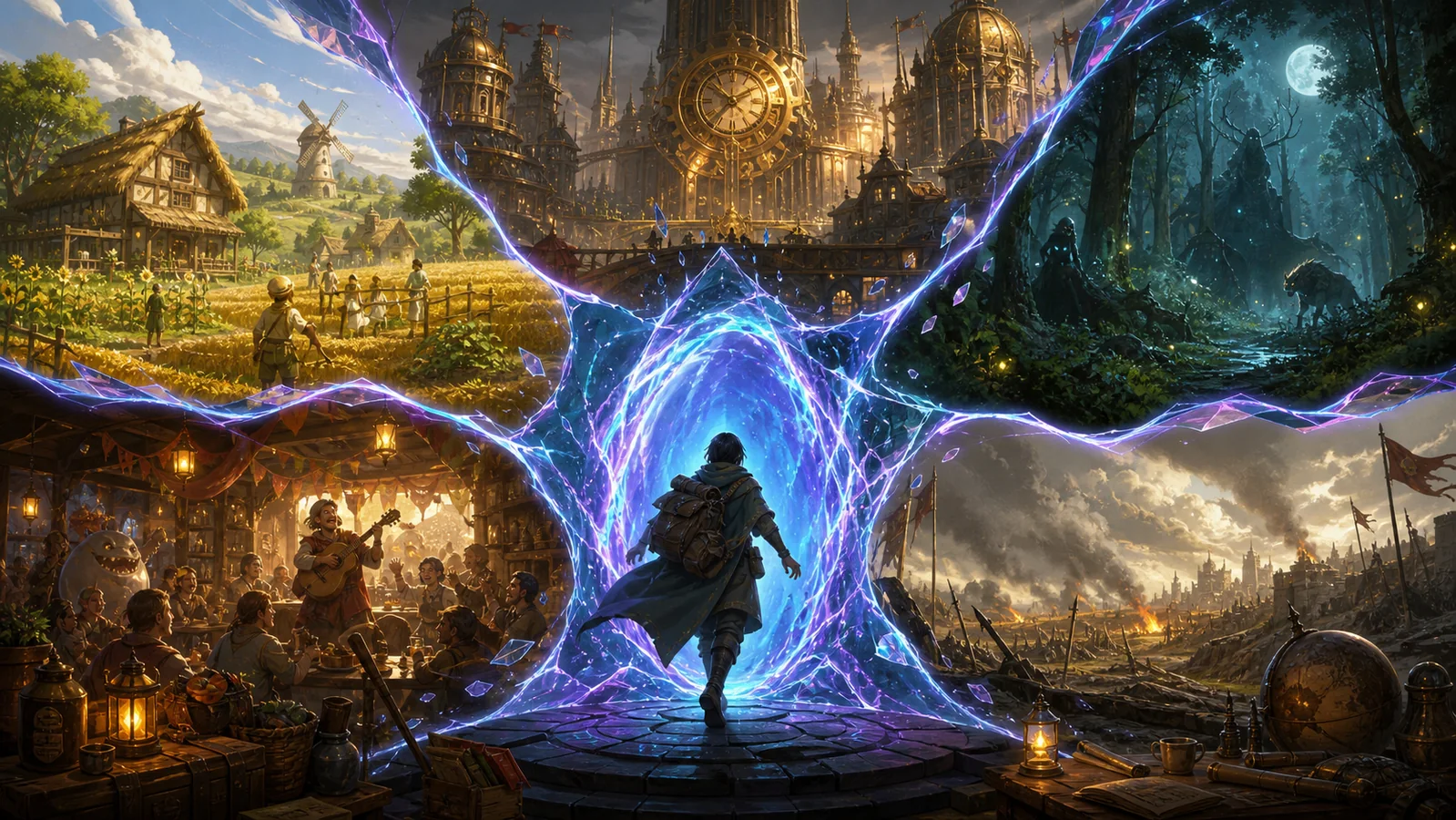
Find an isekai that fits your mood
Another world can be an escape, a punishment or a place that needs building. The best choice depends on which sounds interesting tonight. Re:Zero makes failure hurt; Bookworm turns making a book into a social struggle; KonoSuba lets its adventurers make a mess of almost everything. None needs to offer the same kind of pleasure.
| Anime | Choose it for | Main tradeoff |
|---|---|---|
| Re:Zero − Starting Life in Another World | Psychological tension and difficult growth | Graphic suffering; a longer story |
| The Twelve Kingdoms | Political fantasy and identity | Patient setup; not the whole novel sequence |
| Ascendance of a Bookworm | Craft, family and social world-building | Gradual progress, not constant action |
| Log Horizon | Strategy and governing a game-like society | Heavy explanation and negotiation |
| KonoSuba | A disastrously funny adventuring party | Sexual humor and deliberately selfish leads |
| Handyman Saitou in Another World | Useful everyday skills and ensemble warmth | Fragmented opening; sudden tonal shifts |
| Grimgar of Fantasy and Ash | Vulnerable teamwork and melancholy | Grief; the source story continues beyond the anime |
| The Saga of Tanya the Evil | Military strategy and a morally cold lead | War violence; little heroic comfort |
| Mushoku Tensei: Jobless Reincarnation | An expansive, carefully imagined journey | Sexual misconduct and uncomfortable relationships |
| That Time I Got Reincarnated as a Slime | Optimistic community-building | Powerful lead; some conflicts lack uncertainty |
| The Vision of Escaflowne | Romance, mecha and a finite fantasy journey | Fast-moving melodrama |
| Inuyasha | A long supernatural quest with romance | Repetition; include The Final Act for the conclusion |
Character growth under pressure
Re:Zero − Starting Life in Another World
Subaru’s reset ability is less a cheat than a machine for exposing denial. Failure leaves psychological residue even when events reverse. The series can be punishing and Subaru can be difficult by design, but growth arrives through confronting entitlement rather than unlocking a cleaner attack.
Choose Re:Zero if you want a protagonist whose confidence is repeatedly tested rather than rewarded. The contrast between what Subaru expects and what people actually need from him gives the suffering a purpose. It is also graphic and emotionally punishing. If you want a gentle entry into fantasy, this is the wrong starting point.
The Twelve Kingdoms
Youko begins frightened, dependent and frequently wrong. The world does not validate her self-image; political responsibility forces a slow reconstruction of it. Older pacing and terminology demand patience, but the transformation remains unusually earned.
Its appeal is closer to political fantasy than a game-world adventure. Learning who can be trusted and what leadership requires takes time, so the unfamiliar terms and deliberate opening are part of the commitment. Choose it over Re:Zero if you prefer broader questions of rule and responsibility to the immediate pressure of a repeated crisis. The anime does not cover the entire novel sequence.
World-building through work and negotiation
Ascendance of a Bookworm
Myne wants books in a world where having the knowledge to make them is only the beginning. Materials, money, illness and social position keep turning a familiar object into a difficult project. The pleasure comes from watching a small practical aim reveal how an entire society works.
Bookworm is a good fit if family routines, craft and institutions interest you more than constant combat. Its gradual progress can feel slow, but the obstacles give each gain value. Remembered modern knowledge helps Myne without simply removing the need for other people.
Log Horizon
Thousands of players trapped in a game-like world must build law, labor and diplomacy after basic survival becomes manageable. The series treats system knowledge as a public resource and political risk. Exposition is heavy, but it serves a genuinely collective problem.
Pick Log Horizon instead of Bookworm when you want the group-level problem: how people agree on rules once they have to live together. System knowledge becomes a way to negotiate power, not just defeat an enemy. If meetings and explanations feel like interruptions to the adventure you came for, its strongest feature may also be your biggest frustration.
Comedy with an imperfect party
KonoSuba
KonoSuba understands that a dysfunctional party remains funny only when every member creates a different kind of disaster. It parodies wish fulfillment while preserving affection for the genre. Some sexual humor is repetitive and will be a deal-breaker for part of the audience.
Kazuma’s group is entertaining because an apparently useful ability rarely comes without a personality that makes it difficult to use. Success is less important than the argument on the way there. Choose it for comic timing and petty disasters, not heroic competence. Its sexual jokes and abrasive behavior are substantial parts of the humor, so lighter tone does not mean an all-ages recommendation.
Handyman Saitou in Another World
Saitou brings practical skill, attention and emotional usefulness rather than overwhelming combat power. Short comic episodes gradually connect into a warmer ensemble story. Tonal shifts can be abrupt, but the premise respects ordinary competence.
Saitou is the warmer option if you like a party becoming dependent on someone who is not its strongest fighter. Practical jobs let him matter without a grand destiny. The early short-form rhythm takes time to connect, and comedy can give way abruptly to darker material; give the ensemble room to come together before deciding the format is only a string of sketches.
Danger that does not feel like a reward
Grimgar of Fantasy and Ash
A small party struggles with the physical and emotional cost of basic survival. Watercolor backgrounds and quiet routine give grief time to persist. The anime ends before the larger source story, but its season forms a coherent emotional movement.
Even basic survival requires effort here, which changes the feeling of a routine enemy encounter. The quieter stretches allow fear and loss to remain after the action stops. It is the strongest fit on this list for low-power party survival, provided you are comfortable with melancholy and a season that leaves the wider journey open.
The Saga of Tanya the Evil
Reincarnation places a cold modern rationalist inside a child soldier in an alternate industrial war. Strategy is exciting, but the framing keeps the protagonist’s logic morally uncomfortable. Military detail can overwhelm personal connection.
Tanya is not another vulnerable adventurer in the Grimgar mold. Her competence is part of the discomfort: efficient decisions can serve a brutal system, and her reasoning is often more reassuring to herself than to the viewer. Choose this for strategy and institutional absurdity, not the reassurance of a sympathetic hero making a cruel world kinder.
Bigger journeys and powerful protagonists
Mushoku Tensei: Jobless Reincarnation
Mushoku Tensei makes travel feel like movement through a world with distance, routines and consequences. Places are more than stages for the next fight, and a long personal history gives later choices something to answer to. That sense of continuity is its strongest reason to watch.
Rudeus’s sexual behavior and the treatment of unequal relationships are serious barriers, not minor imperfections in an otherwise neutral adventure. If they cross your boundaries, the world-building may not compensate. Choose it only if that discomfort is acceptable; liking ambitious fantasy does not oblige you to enjoy this protagonist.
That Time I Got Reincarnated as a Slime
Rimuru’s strength is less interesting than the community-building it enables. Diplomacy, production and alliance turn a power fantasy into a nation-building comfort series. Conflict can lack uncertainty because the protagonist’s network solves problems so effectively.
Slime is the more optimistic choice when you want progress to produce a place that characters can share. Meetings and alliances occupy real space, so it is not uninterrupted action despite Rimuru’s strength. The same security can make a confrontation predictable. Choose it for the satisfaction of watching a community grow, not the fear that every battle could be its last.
Romance and classic fantasy adventure
The Vision of Escaflowne
Escaflowne combines mecha, prophecy and romantic tension inside a compact fantasy journey. The emotions are heightened and the plot moves quickly, but displacement remains tied to choice and longing rather than a game interface.
This is the clearest choice here if you want an imaginative journey with an animated ending rather than another installment in an expanding adaptation. The blend of romance and mechanized combat is distinctive, though its emotional turns come quickly. Viewers who enjoy heightened feelings will get more from it than those seeking a meticulously explained game system.
Inuyasha
Travel between modern Japan and a mythic past supports adventure, romance and a very long quest. Repetition is real, but the central cast develops through accumulated travel rather than immediate compatibility.
The reward is time with a recognizable traveling group; the cost is how often the journey circles familiar conflicts. It is a much larger commitment than Escaflowne. For the story’s conclusion, follow the original television run with Inuyasha: The Final Act rather than stopping at the end of the first series.
Still deciding what to watch first?
For a relatively quiet evening, try Bookworm if you enjoy gradual problem-solving. For an energetic comedy, try KonoSuba if its humor suits you. For a sustained emotional challenge, choose Re:Zero. These are different entry points, not steps you need to follow in order.
If finishing the animated journey matters most, choose Escaflowne, or Inuyasha together with The Final Act if you want the longer commitment. For the others, an enjoyable season should not be mistaken for a promise that the entire source story has been adapted. Check the licensed service’s season coverage in your region before subscribing.
Frequently asked questions
What is isekai?
Isekai is a story in which a character travels, is transported or is reincarnated into another world. This list includes game-like worlds and portal or time-travel fantasies where moving between worlds is central to the experience.
Which isekai has no overpowered main character?
Grimgar is the clearest low-power survival choice. Handyman Saitou emphasizes useful ordinary skills, while Bookworm gives its heroine social and practical obstacles that knowledge alone cannot erase.
Are these all action anime?
No. Log Horizon leans into systems and politics, Bookworm spends substantial time on craft and institutions, and KonoSuba puts comedy first. Choose Grimgar for tense party combat or Tanya for military action rather than assuming the genre label guarantees the same pace.
Sources and verification
- Crunchyroll — primary source
Official platform · accessed 24 Aug 2026